As for 40 as beginning, it’s the arbitrary starting line we humans love. January 1st. Birthdays. Anniversaries. First days of sobriety. Conversions and baptisms and strange rituals that indicate to us that somehow everything before was a wash, and everything ahead will matter. It’s, of course, a discourtesy to ourselves and the diligence we spent of getting from one day to the next; nevermind a discourtesy to the others who helped us along the way. We cannot be where we are if we were not where we’d been.
And also.
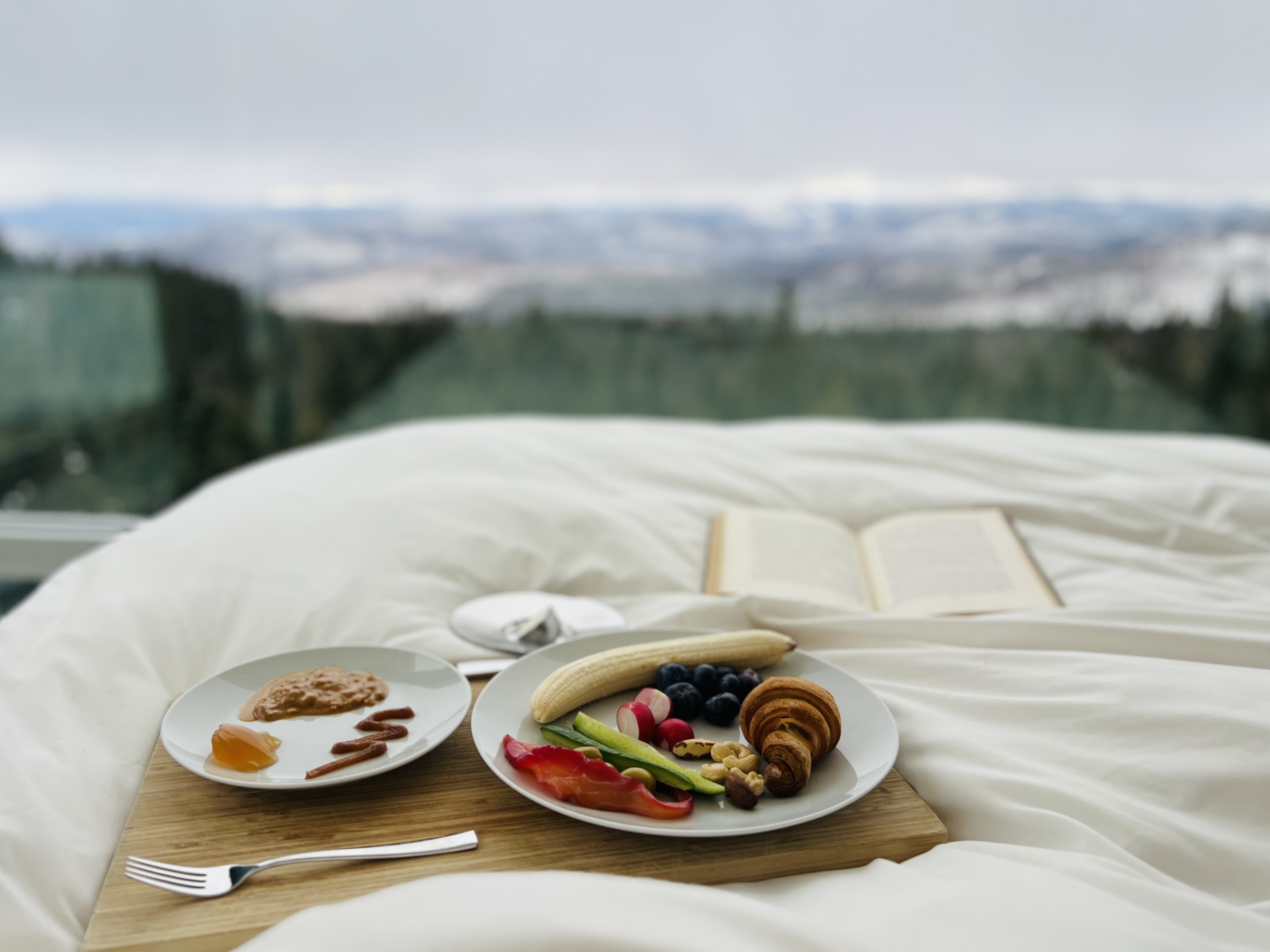
I am sitting in a bed on a second floor of a glass house north of Quebec City, overlooking mountains and miles of dark pines sprouting from land caked with snow. I have a stack of books next to me, am between cups of coffee, and hear my Someone below clattering forks and scraping jars to bring me a breakfast of local croissants and accouterments so that I may write uninterrupted, after which he will also write. This is the culmination of my childhood dreams. In the fray of this moment, it may not appear that way– it’s endless emailing and hustling and moving things from one room to another, or one state to another, in and out and repeating. As a kid, I didn’t know about the latter– about the drivel of daily life; I knew only of the former– the dream that I would be a writer in a beautiful mountainous place thinking my thoughts and eating delicacies from foreign places. Even if that foreign place is only French Canada. I acknowledge that this is not my everyday, and that I did not just “land” here. It is, however, a beginning of a different sort. From this idealistic perch, I am able to see the culmination, the mountain in its various stages from the top and the bottom. It is a fabric loosely gathered of my life so far, and I am able to wrap these four decades around me in the semblance of a tunic, this birthday the sacred wreath for my head. It is a victory in many ways. And like most victors, the winning is merely the beginning of a new cycle of trying for the next crown. And so, I begin again.
The “have it figured out” is another matter. My frame of reference for this particular novelty was ambitiously set by books, obviously. First, by the characters in them, finding their true path or true love or true self by the end. As I grew and my reading became more dystopic, the standard was set by the writers themselves– I should have written a novel by now. Or put out my life’s greatest work. Or have some commercially lauded emblem with a working team behind me and a manager to coordinate my many speaking engagements or public appearances. That’s to say, “figuring it out” to me as a kid meant having utmost control of my own narrative wherein my career was a self run machine and my life latched into a a grid– even a self sketched one– and I would know what a 401K was.
Rather, my life feels floaty most of the time. I do not know what a 401K is. My “team” is my Someone and occasionally my dog, and my manager is myself. And I still use a paper calendar to the exasperation of most of my colleagues and friends.
There is no grid, and frankly no hooks in my life that would allow me to attach to one.
In the case of figuring it out, though, the first version– the one from books– was most accurate. At 40, I have found a true path. I have figured out how to make art for a living– even if that living keeps me tied to the road– while also allotting myself daily walks in the woods, time to write and cook, and a schedule that does not confine me (aside from my own over scheduling). Money is feast or famine, but friends are always abundant, and any good book ends with a gathering of friends rather than a pile of money. I have found my true love, Someone who creates alongside and hashes out the negotiations between my paper calendar and his digital one. And I have found my true self. Or rather, I didn’t ever lose her. I am resistant to call her “the child within,” because the child is not a child, she is just me. When I was a kid, I didn’t think of my whims and penchant for creating as “the child within.” So when I am doing those things, it is not a return to some place I can never go back to, but the ongoing, open studio session I have always been in. It is more accurate to say that the “grown up” is the disconnected oddity. I am more prone to recognizing that the thing I am doing– for instance writing in a glass house for my 40th birthday in Quebec– is a “very grown up thing” to do. My ability to see that lets me know that my true self is still who I know best, and the accomplishments and milestones are merely the projections of irrelevant societal standards. That much, I have certainly figured out. And that is more than sufficient.
And so finally, the dread. What I have been telling everyone I spoke to is, “I can’t wait til my forties.” And this, as seen above, is mostly true. But I knew I would not be sure of it until the day arrived– the day of my 40th birthday.
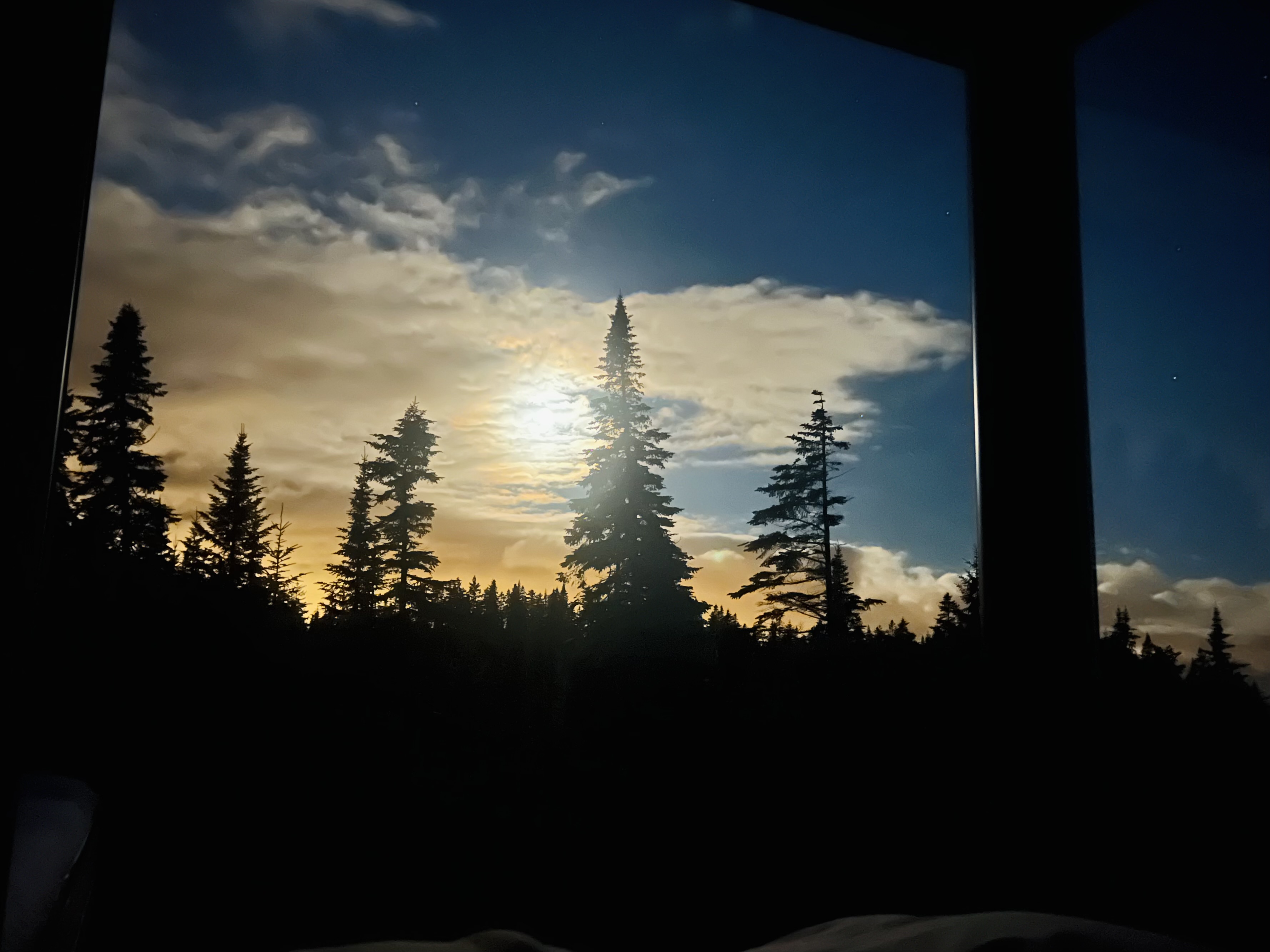
This morning the moon set just outside the windows, glowing like the morning sun behind silhouettes of trees. It was 5AM, and I chose to stay awake, listening to the sounds of a strange house, in the company of a familiar light from a celestial body, feeling the steady breathing of my Someone beside me. My whole life, for as long as I have been aware, I have found myself in these quiet, dark spaces, often in the middle of the night, vastly awake and unable to keep my mind from running. Accompanying these times is also an anxious dread– for my safety, for my loved ones’ safety, for death. I run the scales of what-if’s and worst case scenarios until I am depleted, and the fear itself fatigues me into sleep again.
This morning, there was peace. I tapped the wound to be sure, dissembling a few classic fear standards– car accidents, health– but I could not summon any monsters. I felt at home here, in my body, in my own life. Any imaginings could not change it. I may not yet have lived through the worst that I could create, but I also cannot live while creating the worst I could imagine. Maybe my 40s are, in fact, a truce.
There is also this: if I am to live to the age of any one of my four grandparents, I am already well over halfway to death. Seeing the glow of the moon and the slow shadows of the mountains pool in my view, this thought did bring a bit of dread. I tapped my Someone. He stirred and pushed himself up to one elbow. He didn’t ask me why I had woken him– he knows better by now. He simply looked out the window.
“Wow,” he said.
“What is this life?” I asked.
“What is this life,” he repeated, then wrapped himself around me with his back to the moon and his face toward me. If I have received all of this in only 40 years, I am no longer afraid to die. I may dread it as anyone dreads the end of a very good dream, of a vacation, of a perfect slice of cake. But I am not afraid. It has always served me well to keep going. I dread death, but certainly not my 40s. How could I dread it? I am just beginning to figure it out.
“I’ve been estranged from my father for over a decade,” Susan told me last Friday night, “but it still hit me. Hard. I went to the funeral, and you know what? I’m the daughter. I get to write the ending.”
I felt like I was looking into my future. But instead of dread, I felt hope. Susan hasn’t been slouching on her responsibility to heal. She’s been writing, creating, living a life of kindness. And when the time came, while her father’s death came as a bigger hit than she expected, she was prepared. No shame. No looking back. Just the steady pace of one foot in front of the other that she’s been keeping intentionally, after years of being pushed under false loyalty and abuse. Susan is an emotional hero.
“You’ve got Oprah and therapy and books– there’s no reason to be mean,” she half laughed. She’s right. We have tools we’ve never dreamed of having. The trick, maybe, is to take the time to use them.
I guess, I had written, that this is as good a time as any to forgive my father.
That was June 2023. I’d been bumbling about with that phrase on the daily since. I’m not sure if I’m any closer, or had known precisely what I thought it would look at. But I am more at ease with the room within me that I keep my parents, their things, and the ideas and hurts and memories– good and bad– I associate with them. The specificity of forgiving my father has been since wrapped up in something I declared as “A Year of Healing.” I said it aloud to myself and my Someone and a few close friends, and it’s been holding for this calendar year, though I feel sure the start was in last year’s June journal entry.
I am now halfway through a year of self-inflicted healing. It is a nose dive to the direct parts of me that sting, after a year of being too busy to tend to the gapes and gashes that are still flaring. Emotional health, in this culture, is a luxury. It’s bougie. Until it is coming out sideways and one is considering quitting everything and hiding under the covers for the foreseeable future. There wasn’t really a game plan when I declared “A Year of Healing.” I didn’t have a graph to chart my progress. But the intention is such that I am guided by an impetus, a knowing, that I’ve always known and have recently stopped listening to. Healing was a matter of opening my ears again and letting what I knew to be true guide me.
Damn, this sounds woo-woo as shit.
But the truth is, in my slowed down intentional movements, I can almost hear the squiggle of sinew regrowing and attaching itself, the crackle of scab softening back to skin. I walk on the brink of tears, open and ready, and while that feeling was a waking nightmare to me last year as I was holding it together, this year the feeling is freeing. At any moment, I could sink myself deep into an emotion so rich that I will cry. The only thing different is that instead of fighting it, I welcome it. Like a portal to another world. Or rather, a portal to myself.
I began more intentionally acknowledging The Room within me this spring. My Someone had come down with some awful cold that knocked him out. I figured it was a matter of time before I caught it, but in the meantime, we took precautions wherein I slept in our upstairs loft as he sequestered himself in our room. I delivered meals and activities, and otherwise took over my own space with abandon. Colored pencils and pens and journals everywhere, where I journaled a minimum of two hours a day, trying to tidy up The Room.
I felt ashamed. This room, this place within me, has been all over my blogs, my songs, my conversations for years. I was sick of this room. I was sick of everyone knowing this room existed. And then, in a physical room of my own for a week, I recognized that it is just a room. Everyone has a room within them that is dedicated to their parents– whether their parents were there or not. We all have to contend with where we came from, and what their presence or lack thereof left in this room. We cannot expect that this room will suddenly disappear. It is a permanent fixture. The best that we can do is tidy it up, sort through the things, and with any amount of endurance and time, be able to leave the door open without feeling our insides rebel against us.
That was my goal this spring, I realized. I would return to The Room and tidy it enough that I could leave the door open without cringing. I could walk by The Room and acknowledge its place in my house, and continue about my day without it ruining my dinner. I pushed boxes around. I removed some knick knacks. I replaced some of the stacks of papers with a house plant. I opened a window and let the dust float around. Then I carefully wiped the surfaces down. I shook out the rugs. I investigated the room. In doing this, I no longer felt ashamed. I felt… peaceful. There was nothing in that room I didn’t know about, and if there was, I had the ability to remove it. Or leave it and feel the discomfort. For a month, I walked by The Room and continued the work of uncovering. And while there are still a few broken shards of god-knows-what beneath the table, and an unhealthy amount of dust on a few unpacked boxes, there is progress. I leave the door open. I really don’t mind it in there when the window is left open.
I am lucky, I realize. I have had years of contending this room before Pinteresting it. This room was behind a few walls I had to bust through– a secret room. The big demolition is over, sure. But the work never is. And there is no fear or shame in returning. If I have a conversation with my sister or my mother about our family and some unsavory memory gets placed in that room, I leave it for a bit. There’s enough space for it. But it is up to me how long it stays, or how useful it is. It’s not a matter of ignoring what is put in that room. It’s a matter of finding its place.
When I was growing up, a bear attacked our door up at our cabin in the woods in the Allegheny Mountains. What my parents could figure was that the bacon grease from our previous weekend’s breakfast had brought the bear to us. Judging by the destruction, it wasn’t going to easily give up, either. For the weeks following, when we would leave the premise, all food was locked up tight in the fridge, and a can of bacon grease was carried out and up the hill. We’d stop at the first big curve at the top of the driveway and walk back the can to the meadow where three huge rocks clumped together– the bear cave. We’d leave the can of grease there and depart. On our way back in the next Friday night, we’d stop and pick up the empty can to reuse. We never had a bear attack again.
I’m certain I’ve told this story before, tying it into some offering to the gods. But it’s been floating to mind lately as I consider The Room. While not everything that happened to me is my fault, and this is not an analogy of victim blaming, I do think of the proverbial bacon grease I have held onto in my Room. What has ended up in that room might not be all my fault, but what I choose to keep there is. The bait that allows those historical and emotional bears to break down my front door and make a mess of the place– that, I can choose to let go of, to walk it to the top of the hill. To let it feed some other source that is only destroying me.
Forgiveness, it turns out, does not need to be requited to be effective. At least not always. Forgiveness, sometimes, is a matter of kicking out the bacon grease so the bears don’t eat you alive from within.
And it is in this way that I am forgiving my father.
I do not envy my Someone. In recent years, he’s been conducting his own demolition to get to his Room. Recently, he found the door and opened it to find the place an absolute disaster. He can’t make heads or tails of what to keep and what to throw away. We discussed it safely in our truck as we drove right through the middle of the country, as far away from each of our childhood homes as we can get without nudging to one side or the other. I had told him about my room again after our show the previous weekend when a woman approached me afterwards and said, “Your songs about your parents, god I can just relate so much, and I’m old now but I just think– what the hell? Why am I not over this yet? Why am I back here again?”
For the record, Jane is not old. She’s only in her 70s. And in your 70s is as good a time as any to look at your Room and decide it might need a little more tidying.
“It’s just a room within you that you have to occasionally return to,” I tried. She nodded, thinking, before throwing up her hands.
“I guess that’s the truth.”
I gathered that Jane’s parents were no longer living, which seemed to agitate her more. The Room does not go away once your parents have passed on. This provided a bit of clarity to my Someone after he said,
“It’s just that my parents are always putting things in my room that I don’t want there!”
I told him about Jane. I explained that, maybe it’s true that someone else put something in his room, but maybe it is not. Maybe when handed these stories and memories and feelings that it is really him putting them in that room, letting them tower like a cartoon stack of newspapers bending eerily and threatening to fall. Maybe his parents are just doing the best they can, but because he has not yet organized his room, every offer feels like an intrusion to the ever looming stacks. Boundaries, after all, are not really for other people to remember and adhere to, they are for us to hold to protect ourselves. No one else can do it for us. After all, his parents are just the same dealing with their own Rooms.
The truth of this settled in when we talked about Jane. After all, the dead don’t speak. Unless we let them. The living don’t enter. Unless we invite them.
My Someone was quiet as he drove. I heard an occasional Hmm from him as we got on the interstate. He watched me for years tackle my own Room, not realizing he had one of his own. The best part is that he realized he also had a Room. The worst part is, mine is not the same Room as his– the same things aren’t in there, the same supplies are not needed to clean it. He doesn’t get to skip any steps because of what he’s seen me do. No one else can do it but him.
I am still singing songs about the early stages of finding and cleaning my Room. Now, when I sing them, it is less as a catharsis or as a charge to keep going and more as an historic account. Alongside these songs of pure familial agony are new songs of healing and acceptance. It’s a strange balance. As I have for the last few years, I get regular conversations from attendees who can relate and share, and those who can’t relate and want to give me a hug. It’s not a bad deal, all of this connection.
A fellow songwriting friend recently shared that she felt a sudden responsibility as she has been sharing new songs about grief. She relayed that one of her songs was shared by a listener to a friend of theirs who’d recently lost a child.
“I hope they’re okay,” she said, unsure if sharing a heartbroken song is good to share with someone so unfathomably heartbroken. I’d truthfully never considered it before. I’d always assumed that the truth, especially in the gentle form of a song, is the only contender for grief. Or perhaps it’s only solace. I come back to a core mantra from Glennon Doyle in her book Untamed who said “There is no one-way liberation.” Telling the truth not only liberates you, but liberates those around you.
But the important part, I believe, is that we not focus on what our songs and our Room are doing to others. We can only focus on what it is doing to ourselves. Because it belongs only to us. Our responsibility is not to let others into The Room to judge it, or for us to worry what others think of our Room. It is our job to investigate our own Room. And eventually, maybe, hopefully, that space will become wide open for others to feel the breeze through and to encourage them to investigate their own Rooms.
I hope my friend can go on singing these songs, unafraid. They’re really beautiful, and have liberated me, too.
Like Susan, I am the daughter. I get to write the ending. I used to have chronic dreams of my father’s funeral, and I’d wake up with the weight of wondering if I would attend. If I’d be welcome there. If I’d want to go. Susan did go. She didn’t just go, she wrote the eulogy. She found a way into her room, to navigate it, and she exited lighter.
Susan’s Room isn’t my Room.
But.
I think about the people who have approached me over the years in response to my songs about family. Some regret not fixing it before their parents died. Some hold out and were glad to have never attended the funeral. Some are relieved that they had their last words before death came. They may very well all be right– I’ve never been to any of their Rooms.
It is possible, however, that we put too much pressure on death, on this natural cycle. After all, death did nothing to change the state of Jane’s Room. Death may just be another sign– or in some cases the only sign– along the way to nudge one to their Room at all. For me, I thought I would procrastinate and let death find its way to my Room before I did– a deadline, so to speak. But then, I couldn’t. I don’t think I’d like to write the ending. I think I’d like to write the present, too.
It doesn’t look like anything has changed from the outside. My father still never calls me. But I am coming to accept his contributions in the background of the few phone calls between my mother and I.
It does look like new songs, new recipes, some fresh breath in the same old story. It looks like remembering kindly. This doesn’t mean brushing over the bad. In fact, the good is weighed a little heavier with acknowledgement of the bad.
At my family’s cabin, when I was a kid, I woke up early one morning before the other kids and wandered out to the screened in porch where my dad was sitting watching the lake. I went to say something, and he gently shushed me, waving me over to sit next to him on the porch swing. When I sat, he pointed to a tall tree where a blue heron was perched. “Look,” he whispered. And we sat there, silent, watching the giant bird. I felt my father tense and the bird leapt from the branch, gently and forcefully skimming the water and lifting to a tree farther down the shoreline, a large shimmering fish wriggling in its beak.
“Look at that,” my father said in his regular voice, breathing out.
If not for the silence between us that morning, I wouldn’t have that memory. It’s a good reminder that not all of my father’s silences have been bad. I’ve hung a tapestry of this memory in my Room, even as I sort out the boxes of strained silence beneath it.
And it is in this way that I am forgiving my father.


 Quartz from Pallets