When we swept our floor for the last time, when we jiggled the handle of every door to check the locks, when we wiped the counter from the rings of our water bottles from their last refill, I did not look carefully for what I forgot. I did not worry over each room. I also did not worry over the road ahead. Mostly because, I was in denial. I tried not to look at the echinacea, barely blooming, or the tiny buds in the wildflower garden, tightly held for another week, at least. I didn’t look because I knew I would not see it. The only space I made mention to was my studio, which I swept and called out, “See you in four months.” As I left the studio, I noticed a palm-sized rock on the windowsill. I felt compelled to grab it. It was the rock that came to me two Marches ago on the shores of Iona– a faraway Hebridean isle wherein I spent a few days, windswept and with a distinct feeling of home. I made motion to pick it up, then stopped myself. You’re being superstitious, I chided. Then I locked the door and walked out. I felt a chill in my spine. It was the only thing that felt certain on my return. Everywhere else– everyone else– was a wide question mark, tugging on the boundary of home.
Not that home meant much in its practical sense these last few weeks. I knew I was out of my depth by the pile of laundry stacked on the chair and the unmade bed preceding the departure. Home was no longer a reading nook, a front porch, or even long sit-down meals. Home was no longer winter. And somehow, in early July, I was– of this fact– still in denial. I’d dragged my feet in spite of also wanting this. I want to tour. I want to experience long drives and new places and familiar faces a whole country away. I want to sing my lungs out in Colorado, in South Dakota, in California. And I also could not even imagine wanting it as I watched the sun trickle through the trees on to the bee balm by the porch.
My life is a series of emotional illness. When I am home, I cannot imagine being on the road. When I am on the road, I cannot imagine staying still at home. It is precisely the feeling one gets when they are sick, being unable to imagine wellness, and vice versa. It is not only a state of bodily place, but of emotional incomprehension, an utter lack of empathy for another way of being. And then at once, I am in that other state of being, kicking and screaming all the way, and in adversity to the previous state.
And then comes the unreasonable defense. For all that I love about home, I find ways to despise it. We are too busy there. It’s too much work. Road life is freedom. No one will miss us. It works the other way, too. Road life is too chaotic. It’s too much work. No one will miss us. It is not true, in either iteration, but it is also the only way I have known to cope. I call it “White Fanging.” Torn from the final scene of the movie (I saw the movie twice with my grandmother in theaters as a kid, and numerous times on TV). Ethan Hawke has to go back to society, and knows the wolf can’t stay with him, in spite of their bond. And so, he starts screaming at the wolf, “Get out of here! I don’t even want you here!” and throws a stick to further the point. God, this scene makes me cry just thinking about it. I use this scene as an illustration regularly in my life, like when I have to drop my littlest dog off at her favorite sitter’s house. Or when my Someone and I have to be separated for a day or two (or sometimes just an hour or two). It’s our shorthand to say “I have so much love in my heart and never want to be apart from you, but these circumstances make it that it cannot be so right now.” It’s absolute anguish, on either end. When I am heading to the road, I am the wolf. When I am returning home, I am the man. It is unreasonable and necessary.
As we drove out of our town, sun lowering in the soft ducky yellow and baby cheek pink haze, the rolling green hills of Vermont to our right, my Someone spoke the fear out loud I was desperately ignoring, “The worry isn’t that we won’t come home. It’s that it won’t be here when we do.” Dammit.
For our near decade of transcience, we were either more practiced or more hardened to goodbyes. The fear of leaving a place was not that it would not be there when we returned, it was whether or not we would return. Yet somehow, for a lifestyle wherein so little is in your control, that was the one thing we could control– whether or not we come back. Sure, a favorite coffeeshop or venue may go under in our time away– or maybe even a favorite person would move away. But we’d find another place for lattes, or book a tour closer to where that person lives. That is the difference between visiting and living. I was detached from the change– because isn’t that life? A series of changes? Why couldn’t people simply deal with the shift in tide?
And then I got a home. Not a house, but a true honest-to-goodness home where I plant flowers and I love my community. Bee balm might grow elsewhere, but I do not know the frequenting hummingbird who travels around each flower. There are people I love scattered across the country, but I do not know that Laurie is off from school, and David & Tim are off to Newburyport for half the week, or that Carolyn is sick right now. To be still in a place is to fall deeply in love with it. It is the difference of dating and cohabitating, and I find myself– the flitterer of flitterers– in a deeply committed relationship. And so what I had always dreaded would happen should I find myself in this position has finally happened. I am in love, and I am having difficulty seeing changes. As we drove south on State Route 10, I thought–
What if there’s an accident?
What if an illness wins?
What if someone changes their mind and leaves?
Because home as I was leaving it was John in late stages of cancer. Home was having finally met that charming couple across the river and not had enough time to connect. Home is our friends aging, or needing to move closer to their kids. Or, the ones like us in age, who are like us also in adventurousness– with restless spirits and itchy feet.
I could not bear the possibility of change. And so I did what any rational person would do. I White Fanged it.
“It’ll be good not to have to worry about the garden,” I said. My Someone made a small noise, but it didn’t feel like agreement. So I tried again.
“It’ll be nice to just be kind of footloose and fancy free.” But my Someone didn’t seem to buy it, either. He is accustomed to my White Fanging. So I shut up and did what an actually rational person would do. I missed home.
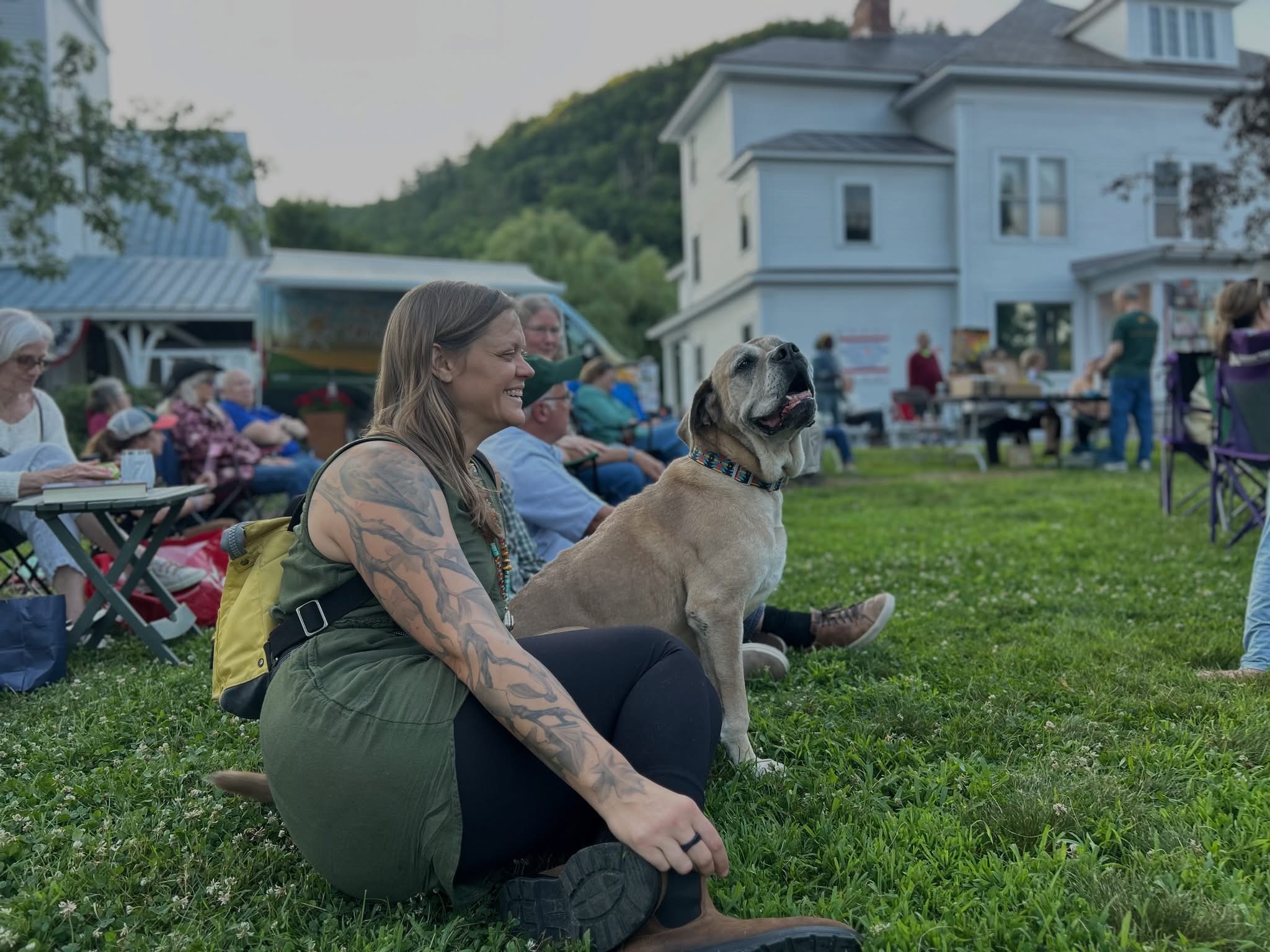
When we pulled up to the concert on the green in the Vermont town just 20 minutes from our house, we were an hour late. Our friends were scattered in lawn chairs, listening to the last few songs of the friends with whom we were leaving our home for four months. As I walked with my dog to find a spot near Tim on the grass, I found myself fidgeting. I scanned faces. I hummed along to my friends on stage to the songs I would hear at least a hundred more times in the coming weeks. I shifted my weight around. I applied bug spray. Then, a woman approached me and showed me her phone. There on it was a picture of me and my dog, listening to music.
“I’d like to send this to you. Put your number in here, I’ll delete it when it has sent. It’s just such a great picture,” I looked. It was. My dog looks content, I am mid laugh, and my friends are a blur behind me. “It’s so important,” the woman continued, “that we have these moments with our old dogs, that we get to keep them, because they are so brief.” I sent the picture to myself and thanked her. And then I stopped fidgeting. I recently read in a book called Earth Medicine by Jamie Sams that the restlessness of the body, the inability to stay still, is often an indication that healing has not yet completed.
The concert ended, and I began my rounds. When I got to John, I cried at him, and he cried back at me, and it was a stupidly tortuous cycle I wished someone would just knock me out from my misery so we would stop instigating each other. He reminded me that he’d be flying to see us in just three weeks, in Wisconsin. It did not help. But it was nice to hear.
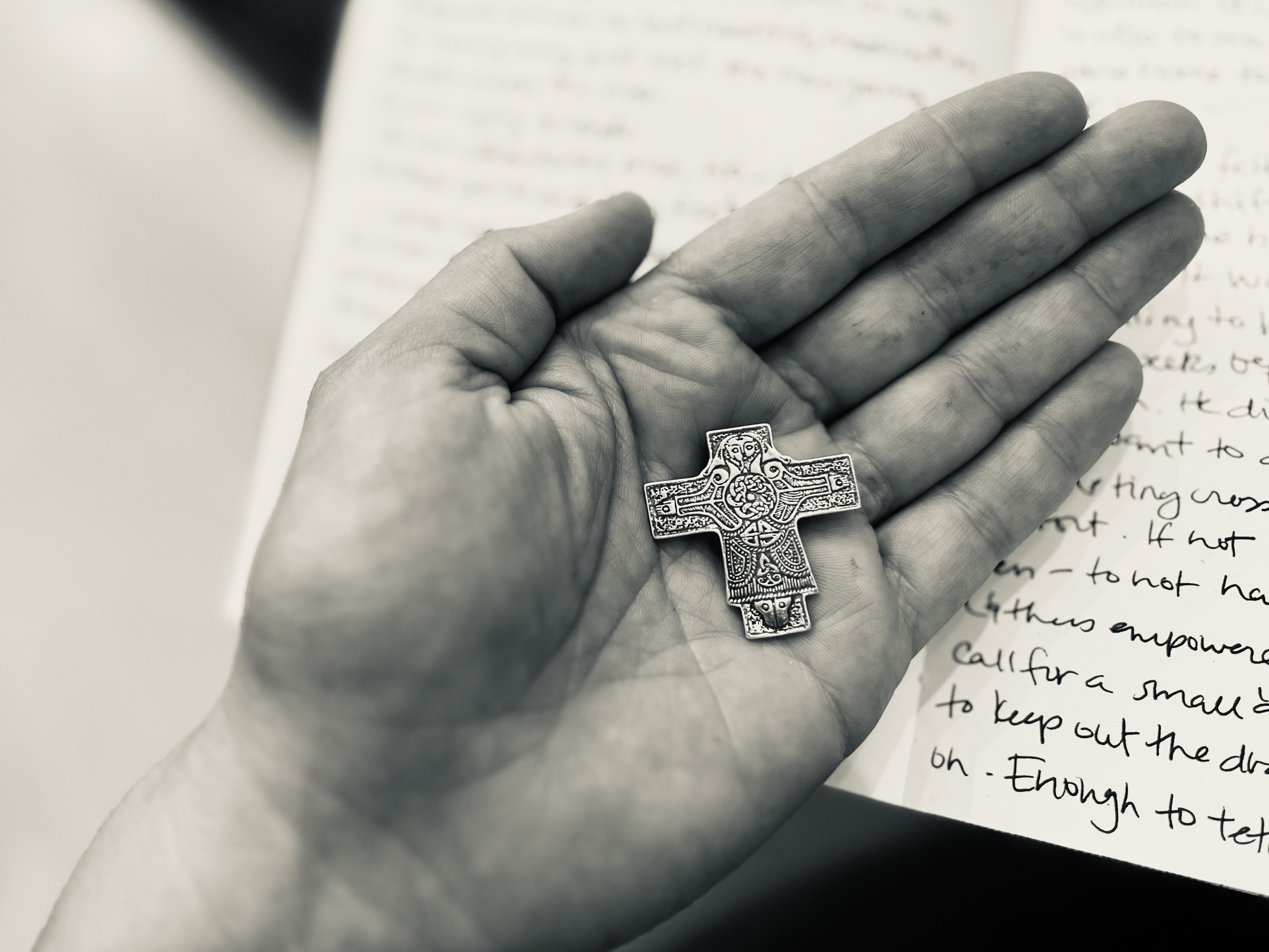
And then, David pulled me aside. Huddled together, he placed a small silver Celtic cross in my hand. He explained to me that it was not a gift– it was a talisman.
“It is to bring you safely home. But it is also to make sure we are here for you to come home to. We will be here when you get back.”
The moment he said it, I felt the fear leave my body. The rock I had left home, the chill I felt in my spine, the prophetic comment my Someone made, vanished. And here in my hand, a tiny silver cross from a faraway isle to dispel it. David is my mystical friend, but also my fellow mischief maker. We each love to pull back the curtain on the Universe and ask for things we cannot see. He’d had a dream two weeks previous compelling him to give me a talisman– the first he’d given in 39 years. The last one returned to him whole, and he was confident this one would, too. I could live with those odds. I squeezed it in my hand til I felt the tiny metal corners pinch. I told him about the rock I’d left behind. “Seems the isles are working to keep you safe,” he said. Yes, all of these tiny isles that made up a single home.
Finally, we departed. I quit avoiding the inevitable and said goodbye to our last friends, Rowe & Laurie, who sent us with the sustenance of the first sugar snaps of their garden. I was nourished and safe. I was no longer captive between two worlds. Certainly, I cried the two hour drive to our first hotel. But for the first time, I was not angry. I wasn’t finding reasons to leave. I was not blaming someone, or making myself miserable in order to move on. I wasn’t White Fanging.
Since I was in Kindergarten, my parents told me that they were raising me to leave. The agreement was that once I graduated, I had one month to get out of the house. No coming back. There were no circumstances– divorce, unemployment, accident, anything– that would allow me to call my parents’ home my residence. When I graduated from college, I was gone in two weeks. I remember my mother being surprised with my speedy exit, and I reminded her what I had been told at least once a month since I was five years old. “I mean,” she said, “but there are exceptions.” It was too late. It was nurtured into my fiber that my stay in a place is short lived before I am no longer welcomed.
This is not something I blame my parents for. I’m grateful for it, now, in a lot of ways. But it is something I still have to heal from. In the same way some of my other friends have to heal from parents who were too clingy. I have lately abandoned my belief that my parents messed up, and choose instead to believe they did the best they could. It gives me the ability to oversee my own healing.
Maybe it is this forgiveness that allows me, at last, to not resent the place I am leaving. I have made space to let myself be welcomed home, again and again. To be loved. To not be driven away– or to drive myself away. I don’t need to protect myself from home, because home is love. I have made space to believe that– even if it is only a space as small as a silver cross from the Calf of Man: that is enough to tether me home.
 Quartz from Pallets