writing

And On Day 9, She Rested.

Day 2

I woke up here, on this island. I have no history, no identity, just a sense of belonging here only and always, and four incisions bruising on my abdomen. I hear everyone telling me to take it easy, to rest, to not worry. But I don’t worry. There’s no where to go here. The moon was full last night, and made the snowscape bright and reflective like glass. I awoke every three hours to alarms, telling me to take another pain pill. Tylenol, then ibuprofen, then Tylenol. They are the waves on the shoreline, and I am listening to them come in before sleep. At the 3AM, I willed myself to stay awake longer. The moonlight was too bright to close my eyes on, and it was too strange to see the night so bright that real, firm shadows formed on the ground. I spend the following day watching the same shadows from the sun. It was 1 degree in the morning, so cold that the hinges on the inside of the front door were frosted. My mother called. I don’t know how she found me here, or how I knew she was my mother. She said she made gingersnaps, and yesterday pizzelles. “It’s not Christmas til the pizzelles are made,” she said, and I wondered what was Christmas and neither judged nor resonated, only accepted that somewhere off this island, there was Christmas, but it didn’t effect me. Here was only wind that smacked snow to the side of every tree, slathered like white mud, making every tree a birch. I can’t imagine a prettier island, to exist in the center of a wood of cold birches. The winter day is closing its dense, blue eyelid. Here comes sleep, then alarm, sleep, alarm, and I hope for the moon to break up the night.

I love it here. But I get the nagging sense that I will have to leave someday, and it grieves me.

Day 3

There are prints that lead beneath the house in the snow– they look too large to be a squirrel but it’s too hopeful that they belong to a rabbit. I’m pleased to know that there is other life on the island, even if I am still too slow to catch it. I watch icicles like television, the prisms casting color before they frost over like teeth, dripping with hungry thoughts of spring.

Spring is a new idea on the island. I’m grateful it does not come here. I can’t imagine the chaos of vines and leaves whipping themselves around, mussing up the simplicity of a white blanket and footprints and the skeletal tan beech leaves I could count.

Day 4

It’s my fourth day on this island and the strangeness has worn off to normalcy. In fact, it is only strange that I ever believed in a world beyond the snowy sea. Complicated schedules and maps and to do lists have distilled down to baseless things. The only reigning importance is this: nourishment, bowel movements, deep breathing, sleep, and an occasional exploration of the perimeter. I am bodily reduced to these touchstones as before my mind was strengthened to perform complexities which on this island, I cannot fathom. Text messages come in like foreign postcards in the claws of gulls, indecipherable to this small world I inhabit. One ship has perched on shore, but brought no new news, only supplies to further my wait here. I will not starve. I will wait til the waters dry up and the boundaries soften and what happened here will little matter except that I knew only this for a time, and this was my home, and I was content to survive without curiosity and with contentment. The bright white out my window will sear like a memory blanket behind my eyes as I fall asleep and wish for the deep rest I have found here alone.

Day 5

And now time has snapped back into place. The island was an illusion. These things exist, in no particular order of importance and with equal certainty–

Monday
my body
my neighbor’s house
Europe
schools
seasons
music

Also, I have become aware of
schedules.
lists.
tasks.
Monday (again).

The realization is as shocking as it is normal, and I already mourn for day 1, 2, 3, 4 of a floating poet of no consequence who nearly lived a life into oblivion.

The biggest, most prominent awarenesses may be:
– a ticking clock

which leads to:
– irritations
– reality
– change
-clarity
-mournfulness
-regret
-longing

Oh, and look at that. Dashes. I have structured my lists, conditioned from the Before Time. I am not gently unraveling but forcibly conforming. Heart rate, higher. Motivation, momentous. Productivity, impossibly expected.

The island was not an illusion. And I was trying to fight to leave it too soon. My body not ready, my mind pushing forward. All of this time can’t be wasted. I began to panic. I pushed harder, walked longer, wore myself to pain, balled up my will and tried again. I exhausted myself on Day 6, walking outside in -12 degrees for over a mile, collapsing the rest of the day. That night, I told my Someone I had to write a book. I scanned the internet (it existed suddenly on the island), and realized much was expected of me. I should rest so that I could write a song. I should rest so I could write a book. I should rest so I could do more more more more more more more more more more more. I should rest, because rest means I can be better, bigger. There will be something to come of this rest. And if there isn’t, well, perhaps I did not take my rest seriously enough. I began making ridiculous goals. If I couldn’t sit upright to be productive in making books– hard as I’d tried– I would instead read books. An impossible number. I would finish at least one a day. I would consume books to prove that I am filling my well for future creativity. People would look at my online ledger and wonder how– HOW?– could anyone read this many books in such a short amount of time? Then, I made possible but fraught goals. I would do yoga every day. I would practice piano every day til my abdomen hurt. I would complete one mundane task a day. Suddenly my days of rest were so regimented, so riddled with expectation, I wished for the days before I rested so I could rest again.

And that’s when the spiraling began. Because I couldn’t– I physically couldn’t, not even to account for my mental capacity– hold up the weight of these expectations. I’m not even allowed to lift 5 pounds, let alone the hundreds of pounds of self imposed standards. I fell flat. It snowed that day, usually one of my favorite days. But as it piled up outside, I felt the weight pressing down on me. I became bitter, remembering when a snow day meant rest, and now a snow day means fighting the rest. I gave up, at last, and put myself to bed. A two hour nap. When I woke up, I made hot chocolate– with help lifting the maple syrup. I began a puzzle. I justified it as a snow day, but I worried that it would be the same tomorrow, the next day. And I still hadn’t written that novel that was supposed to come from all of this rest. I wished for exhaustion and got it, sleep without rest.

The next day was the same. I now lived on the shoreline of the island, unsure how to leave, unsure how to rest. I would leave. I would leave tomorrow.

I woke up angry, annoyed. I shoved myself into the small boat and pushed myself from the island I loved. Not because I wanted to leave, but because I felt like I had to. I didn’t deserve this place. I’d already overstayed. It was Day 8, for godssake. I couldn’t check out forever. Once out at sea, the waves grew more harsh. My body couldn’t handle it. My thoughts became the thrashing waves, a ship of haze– unrelenting, nonsensical, and from every direction. I became disoriented. I became a ball of defiant energy, a little work force of resistance, of fear, of small brutal efforts. And then I became a mouse at the bottom of a boat, running back and forth.

And then, another boat appeared. Lindsey. She tethered her boat to mine, lobbing over a bag of roasted eggplant tomato soup and fresh squeezed orange juice and a small gift wrapped prettily in orange paper. Then she sat with me in the middle of the sea while I tried to pretend my tears were just the water sloshing around. She’d been here before, in this exact part of the sea. It was a little and a long way to go, she said. She had a map, and showed it to me. I couldn’t make sense of it, but I love to see maps, and it made me feel calm. She stayed very still while I sometimes raged and punched at the water. When she left, I was still drifting, but toward somewhere. I let myself be pushed around as I did the gentlest yoga in the middle of my boat. I let myself think–

Who am I if I am not helping? Contributing? Performing?

I let myself think–

What happens to me when I am reduced to I AM, I AM, I AM.

I let myself think–

People are allowed to be not useful, but I am not allowed to be not useful.

I let my ideologies be pushed around. I thought how I believed somewhere that I would heal better than anyone else. I thought how I was in competition, to be better at getting better faster than anyone else. I thought of the merit of my own body, and then the merit of having a body unable to serve. I remembered a foreign postcard text my friend Dani sent me on Day 2, when she said, “I hate when reality screws up my positive thinking plans. And all that stuff that happens to other people certainly won’t happen to ME. Yep, reality bites.”

And then I thought, I am not special to be here in this floating sea alone and capable. But I am special to be in this floating sea where other people have been floating before and know the place that I am floating.

I thought– what is the lesson?

I thought– this is the lesson.

I thought– because there is no lesson. At last.

Day 9

This morning, I awoke in the world I left before surgery. I thought, “I would like to go to a bookstore soon.” And it seemed strange that I would want to go, but also that I remembered what a bookstore is. How decadently normal. My Someone has set up two bird feeders on a shepherd’s hook in front of my bedroom window, and when he delivered coffee to me in bed, he opened the curtains and I was shocked and amazed to see it. All day I’ve stayed in this room, even though I don’t need to stay in this one space. I’m well enough that I could leave. But I am choosing to stay because so far I have seen chickadee, titmouse, nuthatch, bluejay, and a hairy woodpecker, and I can’t stand to miss a minute. I read a poem this morning that said True creation is always purposeless, without ulterior motive.* It reminded me of an island I used to live on. I read more of the poem and, for the first time in months, I felt the poem touch my heart. True rest is also always purposeless. They have always been attached, twinned, but necessarily separated. Rest and creation cannot see one another, or the spell is broken, and they both disappear. I do not rest to create, or I do not create. I do not create so I may rest, or I will never rest. Today I remember my island, and I rest.

And here, by accident, create.

*”Fugue,” by Hayan Charara from These Trees, Those Leave, This Flower, That Fruit

To Be Small and Alone and Alive

I have been lately in recovery. Or rather, I’ve been in attempt to recover my childhood. Not dredging up memories or sorting family history with the perspective of adulthood. But mining for the pockets of being a kid that made me feel alive. Some call this “childlike wonder.” But I’m not interested in being childlike. I don’t want to diminish the true and real magic of sinking into one’s own imagination in terms of likeness, or in terms of condescension. I am not trying to “act like a kid,” but to be myself. My whole self.

While my Someone was in California last month, I had the house alone for the first time in our three years living in New Hampshire. Our home is a cabin at the end of a dead end street with a thick edge of forest. In the spring, the birds are so loud it’s sometimes difficult to hear one another when we sit on the porch. As summer wrapped, under a moonless sky, I could hear everything. Every shift of leaves under the falling acorns. Every rustle in the woods– a bear? a skunk? a fox? a weasel? (we have them all)– that had me on edge as I tried to play it cool on my porch swing, sipping NA wine and reading a book. Something about the fear, the bumps in the night, took me somewhere else. I texted Annie– “I think something is in the woods?” Intuitively, she Facetimed me right away. We chatted for a good long while, until she said, “Well, do you feel better?” And I did. We hung up and I waited longer, letting the sound of crickets overtake the real-or-imagined bumps in the woods. We had only last week had a bear come and mangle our bird feeders and shepherd’s hooks. I double checked that I had brought the feeders in. I had. And then, I stood up, unplugged the lights, and walked to the front porch steps, and sat down. Above me, the stars were blazing. The dark wrapped me up like a blanket, and I watched as one, two– was that a third?– shooting star passed between the crowns of my trees. I was not afraid of the dark, it turns out. I was afraid to be standing only on the edge of the dark, to be separate, to only stand on the precipice of living rather than saturating myself in the deep of it all.

In Madeleine L’Engle’s book Walking on Water, she writes an entire chapter on the ages we hold within us. When we grow to be fifteen, we still carry our five-year-old self, our fourteen-year-old self, our just-born self. I reference this on occasion, but usually in terms of justifying my joy or explaining my little-“t” trauma. The real point, I think, is that we don’t lose anything by growing older. We don’t lose our ability to imagine, to create, to be fearless and uncritical just by gaining a year and perspective. We are not just allowed, but are necessarily required to call on these younger selves to navigate the world around us. To censor them is to lose ourselves. Which means that to try and recover my child-self– I am not finding something that is lost out in the world, left like a doll on a riverbank– I am simply resting my 39-year-old self and my 38-year-old self all the way back until my 6-year-old self can have the space to move without criticism or restriction. I am not becoming a kid again, I am a kid already. Everyone else can take a nap.

The thing is, when I was a kid, I didn’t think of myself as a kid. Don’t you remember how you bucked and brooded to be left out of adult conversations? To be told you weren’t old enough, that you were too young to understand? I knew in my mighty small heart that I could handle it, that I contained otherworldly knowledge that could not only be trusted, but could be the key to the lock of poor adult judgement. Of course I did– because didn’t I always have to explain to those stupid adults the picture I just drew? The intricacies of story, the Easter eggs planted throughout, the intention behind using yellow instead of red when it was all so obvious to look at? So to be a kid again is not to act with immaturity, but to set forth with utmost confidence, to believe the thing we are born with– that we belong, that we understand, and that we are important.

During my weekend alone, I spent each night on the porch reading. Then I would shut off the lights and look at the stars. I felt the habit growing in me– to look up. It felt like reconnecting. I continued to do so after my Someone returned home. Instead of working until 10, unwinding with a show and calling it a night, I stopped our work at 9:30. Whether he would stop working or not did not deter me. I would sit on the porch, I would be quiet, and I would look at the stars. I lulled my thirties to sleep this way. Then my twenties. And by the time Laurie asked me to come and teach a short bookbinding project for a couple days at the local elementary school, I’d finally found her– the Preteen that would stay up late writing poetry, drawing, and losing time to listening to the same record four times in a row.

The night before my first class, I went to my studio late. I would just put something quick together– a little book for the kids that they would get the point and I could move on and go to bed. But then I remembered what it was like to be a kid. How “kid things” were unappealing. And then I put aside my belief of myself as The Adult Teaching Kids and became a kid. I worked on my little book and 10pm became 11pm. I would miss the porch tonight, but I didn’t mind. There was no music on– just the sound of the crickets outside and of scissors cutting, and of a glue brush swiping across the paper. When it was finished, my Someone had given up and gone to the house, and it was 2AM when I followed.

I cannot remember the last time I fell into a creative portal til 2AM.

I had made a book. But more, I had found something of myself. The class went well the next day, I was still energized from the making. I hardly used the book in the teaching, but it didn’t matter. I am in recovery, and will always be. Because to let my younger selves take the reins is not just an act of discovery or healing, it’s prudent to preserve my well-being. And it’s the living.

This is my little book. It’s about how I felt as a kid to read. Luckily, I am still that kid, and it is also how I feel now.

Short Cuts & Snake Bites

Susan in Greeley, CO spent her career as a physical therapist. She told me most often, people are injured simply because they are not paying attention. They have decided to take a short cut, or feel hurried, or take their mind from the thing they are doing in order to save time or mental effort and– crack, bam or twist— that’s when it happens. It is in these moments that their mind goes one way and their body goes another.

The mindfulness movement isn’t new– it’s ancient. But it’s been in a Renaissance of sorts, with words like “intentional” and “being present” seeping into the vernacular. My Someone’s grandma, whose memorial my Someone is attending this weekend, called it “Keeping body and soul together.” She was a devout Nazarene, and would likely be horrified to hear that phrasing in reference to my yogic practice. So I kept my delight of our shared sacred belief to myself, feeling strangely connected when I’d hear her ask her grandson at the end of their phone calls, “Well, are you keeping body and soul together?” Like trying to keep the vinyl floor glued down, or Wendy stitching up Peter Pan’s Shadow to himself.

The irritation with paying attention is that it takes time. There isn’t a short cut to not taking short cuts. It is an agonizing, unrelenting process that quite literally comes one step at a time. And if you aren’t paying attention– well, then you’ve already lost it.

Photo by Scott Tyler

I was thinking of Susan when we walked the low sloping hills along our campsite in the Badlands last month. We were going to see these natural phenomena with our friends John & Becky, who’d flown all the way out from New Hampshire to spend a week with us on tour in South Dakota. While they’d stayed in a hotel, we’d slept in the park under a drape of stars the night before, listening to the coyotes yip close by. John & Becky would be meeting us in the morning for breakfast, before it got too hot to bear, and we hopped-to to get the dogs a walk before their arrival. We’d been walking for more than 20 minutes or so when it felt like time to turn back. I didn’t want to be late. My Someone and I looked back over the path along the ridgeline, realizing we’d gone further than we thought. Then we took a look down the slope of the hill, tall grasses and an occasional cactus that led down to a faster road back. Susan’s words began to press on me, but I pushed through them in favor of the press of time that is almost always pushing on my skull.

Then a new feeling passed over me– something was wrong.

“Snake awake!” I yelled, a mantra we’d been shouting since we saw a sign that read those words back in Colorado.

“Snake awake!” my Someone yelled back, laughing. But I wasn’t laughing– I knew.

At that moment, ten feet into the uncharted grass, my littlest dog stepped on a snake. I pulled her back, hard, and ran us back to the dirt path. I checked her over, frustrated. The press of time suddenly didn’t matter. I saw nothing– no mark, no reaction. We took the long way back. When we arrived at the bottom, our friends Michael & Erin were there waiting– we were in our last week of tour together. I recounted our walk, the snake, and just as I said “And I guess she didn’t get bit after all–” my Someone pointed to her foot.

There they were, two bright red dots on the foot she’d stepped with, perfectly sized to the small snake I’d seen. Now, I pushed the rush of my head down and began dialing John & Becky. My Someone packed the truck and called the local vet.

“Can you go with John & Becky to see the Bandlands today?” I asked Michael and Erin. Of course, of course. And we were on our way. When we finally got to better service, just a mile up, I got hold of the Visitor’s Center, then another vet. They both had me describe the situation, the size of the snake, the color, my dog’s reaction. And both assured me– no, everything will be all right. Keep an eye on her, but there is almost assuredly nothing wrong. The dog is big, the snake was small, and the likelihood of it being a rattler– even a small one– is low. I hesitated, then took a moment to put body and soul together. I listened. And then, yes. They were right.

We returned to the campsite where all of our friends were waiting. We ate heaping bowls of oatmeal and slurped our coffee and everyone doted on my littlest dog, telling her how brave she is, watching her for any indication of poisoning. I felt my heart rate decrease. And my littlest dog got a first class ride in Michael & Erin’s van for the day to monitor her as we all went to see the Badlands.

No more short cuts were taken. It was a really stunning visit.

Photo by John Foster

When we returned from tour, my mind was brambled from the trip. My Someone’s grandma had passed away. One of my best friends had lost his dad. And also, my mother was coming to visit. My mother, who has not in my adult life come to visit me– just me. My mother, who I have been estranged from for several years. This atop the stress of travel, of hundreds of people and personalities and no time to take it slow. So, just as with last August, Rowe & Laurie helped us secure a canoe and some gear, and we headed to the Green River Reservoir in Vermont to watch the beavers swim and the loons nest and the water change color with the sunlight.

On the first morning, they took an early paddle out while my Someone and I stayed back. I began painting a little book I’d brought along beside our morning fire and coffee. When they returned, I made motion to get up when Rowe said–

“No, no need to go yet. You’re doing it. You’re doing the thing we come here for.”

“You mean wasting time?” I said.

“You’re not wasting time,” he said quickly, “you’re embracing it.”

As it turns out, there are no shortcuts to embracing time. You simply have to spend it as it comes. I thought of this as we paddled in the morning, ate our lunch by the water, swam. I thought of this as I lazed about starting a new book and reading it for consecutive hours, breaking for a small nap in between. I thought of this the next morning, when I woke first a little before five, and felt called to embrace time by touching the water. When I dipped in from the rocks, the fog was still on the water and cast in a pink glow from the sunrise. I soundlessly submerged myself to my neck, and as I waited, patiently asking myself to embrace time, a little creature’s head began moving toward me. I gasped, but he was undeterred. The young beaver swam, turned, and swam again, making circles around the spot I was treading water. Finally, he swam off and didn’t return. I took it as my cue to finally swim forward, out to the little island in the middle of the reservoir. When I got there, I stood up on the rock, and my little friend caught sight of me in my full height from the shore. He slapped his tail in warning– I was not what he’d expected.

I waited a little longer, making sure I wouldn’t be interrupting his morning work, and when I didn’t see him, I tread back in to swim to shore. Within three strokes he appeared again, and swam alongside me, just a couple of feet away. We swam like this til we arrived back to shore. I stayed in the deep for a while, watching him chew industriously for several minutes until I was sure my presence would bother him. When I returned to the rock, he pushed from shore again and swam toward me. It was the closest we’d been in our time together. I saw his little eyes glistening and the texture of his fur, his nose moving with the intake of breath. And then, he was gone. When I left the water, I did not feel as though I had embraced time. I felt that time had embraced me. I swam with a beaver for 45 minutes. It was at least my best guess as I saw my friends emerge from their tents around 6.

I was grateful to see Laurie first. I couldn’t spend another minute keeping this little piece of magic to myself. Or rather, I could only spend another minute, the next minute, one at a time. I didn’t take any shortcuts. I told her every detail.

The visit with my mother went well. More than well. By the end of the weekend, it was as if we’d recovered something. In some way, we had. But it wasn’t time. I kept reminding myself after I dropped her off at the airport that the time spent apart wasn’t wasted. In order to keep body and soul together, we had to remain apart. Relationships are the body of two people. For these years, I became mindful of this body I share with my mother– how it works, how it doesn’t. And I remained mindful of it when we were physically together again. For the first time, I felt like myself around her. And I kept my mind on this shared body– I listened harder, I noticed more, I welcomed her like I’d learned to welcome myself in this time we spent apart.

There were no missteps– no emotional twisted ankles or metaphorical snake bites. Because we had not taken any short cuts to get here. We endured the painful, long road of healing. I could not have fast forward through the anger, the grief, the despair in the same way that she could not race through the regret, the ache, the distance. We took our agonizing time. And while we may not be running any races now, we are at least walking the same path again. Slowly. Keeping body and soul together.

What I Learned from Being Kissed by a Wolf

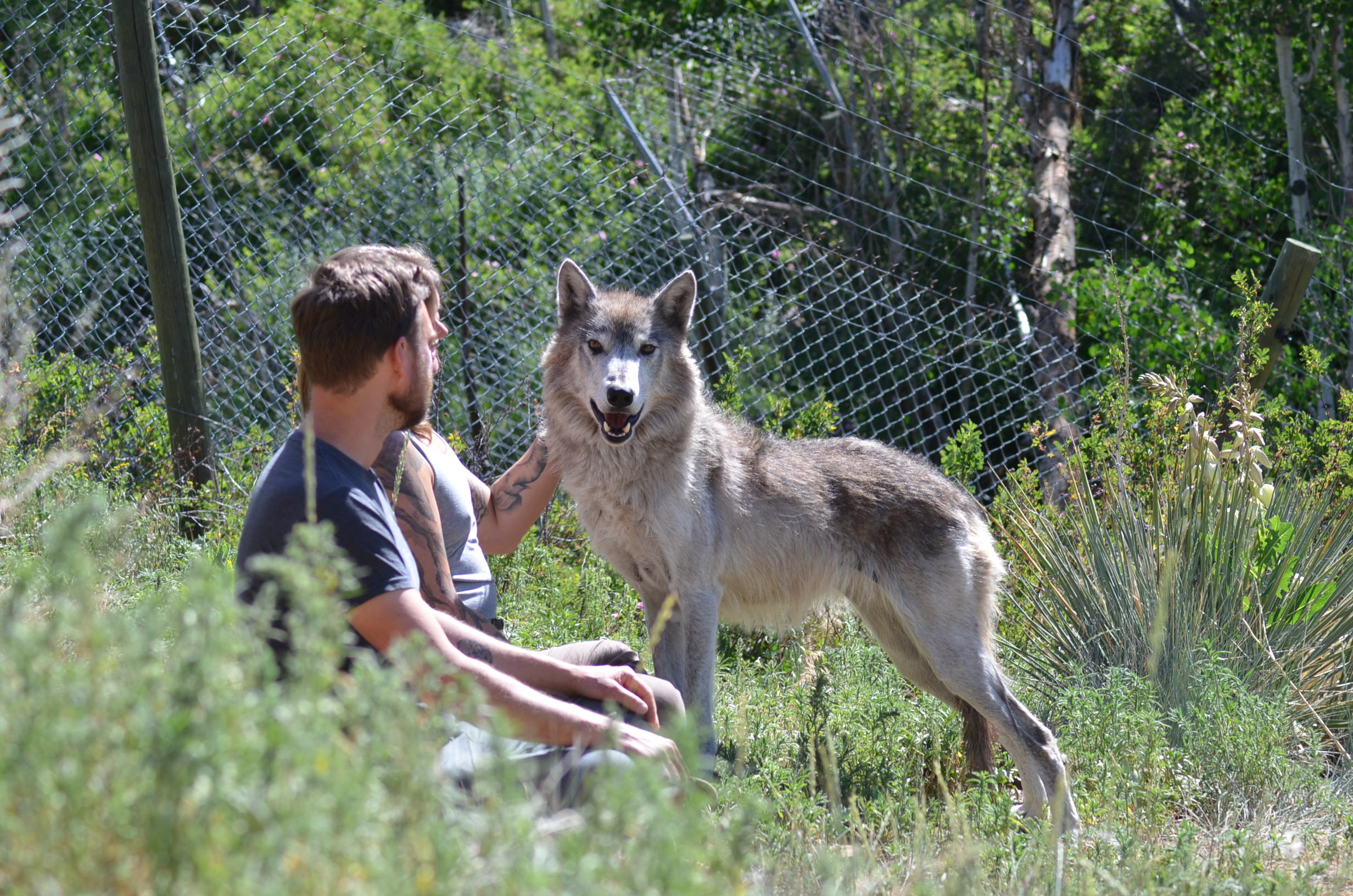
There is a wolf rescue in Westcliffe, Colorado– way back along several dirt roads and a few foothills. This rescue has one objective– if it’s good for the wolves, they do it. It’s been running since the year I was born, 1986, and the founders are calm, generous spirits who you can sense possess the half wild that humans dream of when they are kids– the in tune nature we possess before formal clothing and social expectations wield their way over the freedom of bare feet and sun on our skin.

We’d played a show for a group of 90 or so in town the night before, a favorite on the folk circuit. So much so, that our fellow folky friends reminded us over lunch on our way down– “Don’t forget to see the wolves.” This was our third time to Westcliffe, and both times before we’d forgotten to see the wolves. We are always in a hurry, and are working on that habitual flaw. So we called our host Bob as we drove down to the show, as a reminder to ourselves and a commitment to upkeep, and told him, “We have to see the wolves.” He obliged.

We took a quick morning run with our very tame dog, stopping at a local coffeeshop where the barista was chatty and asked us what our day would bring. “The wolves,” we said.

“Are you going to let them lick your teeth?” he asked.

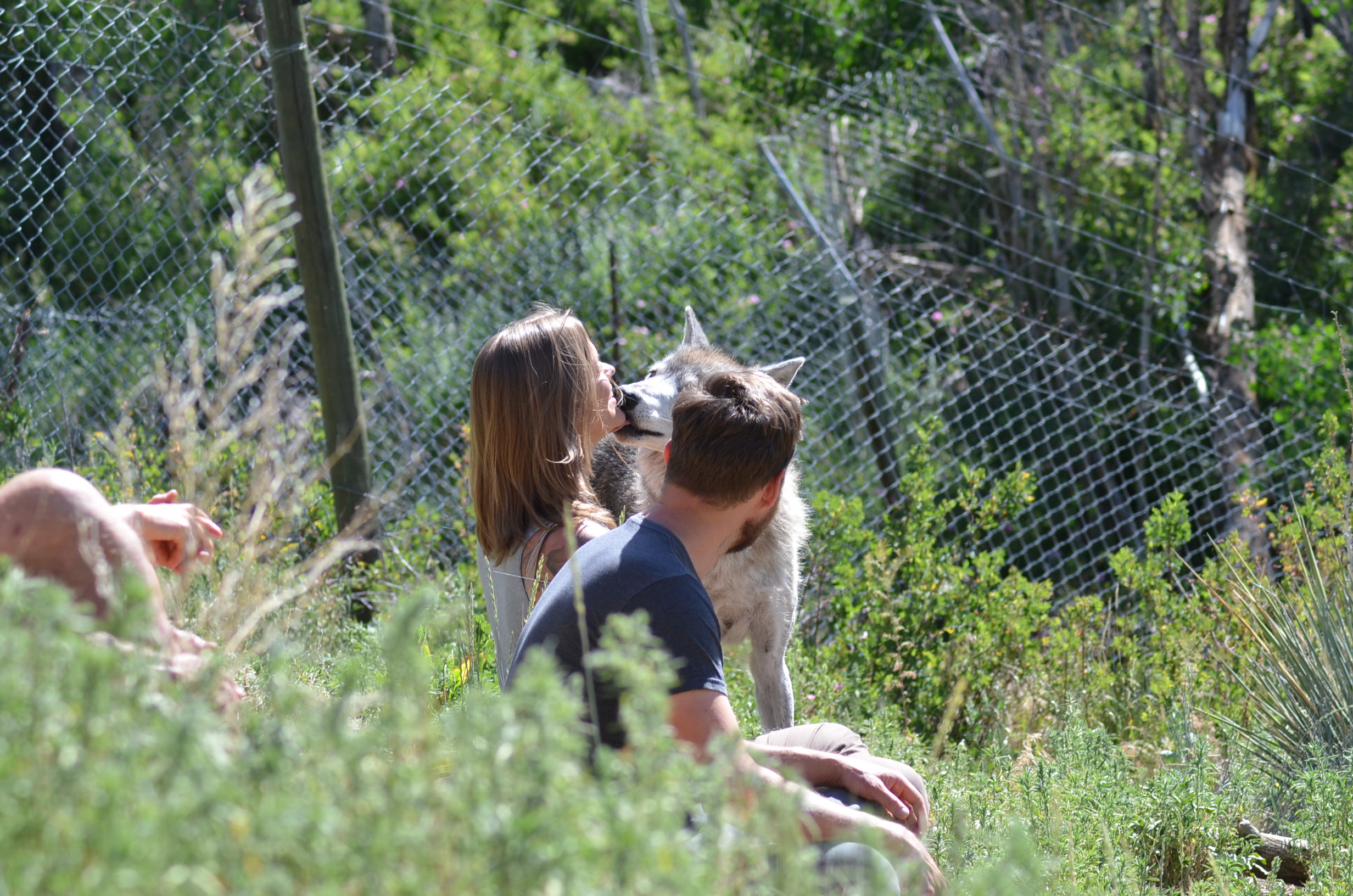
Without hesitation, I said “Yes. It’s all I can hope for.”

And it was.

When You Go To Meet the Wolves, there is no guarantee they will greet you. They are wild, or at least half wild, and it is in fact very weird for them to want to approach. But if you are a very careful and a very lucky human, it can happen. And when it does, you must:

  1. Walk in with your shoulders back, looking around. Women are typically better at this, as they have been conditioned to be multi-taskers, watching cubs & prey & predators at once, chronically aware of danger and potential danger. Men, on the other hand, have a tendency to stay narrowly focused, hunched, and singularly minded. This inability to be open does not warrant the respect of a wolf, and just as the man ignores his wider surroundings, so he will be ignored by the wolf as neither threat nor peer.

    When I enter a room now, I will keep my shoulders back and my senses awake. My presence may feel threatening to some, but to those that matter, I will appear as an ally.
  2. After entering the den, look for your spot to sit, and sit down like a Queen to her Throne. Face up, shoulders back, alert.

    I would add to this, deep breaths. I am in more danger by believing I don’t belong somewhere than to believe that I do.
  3. When the wolf approaches and makes eye contact, look back. This is contrary to what we have been taught of wild animals, and contrary to what we have come to believe about people who are different than us. Anyone who cannot hold eye contact with a wolf is neither friendly to their approach, nor worthy of their time. For people, the same.
  4. Do not be on your technology. Hunching over and staring at a phone creates a hunched back, a downward gaze, and is not the behavior of a guest. It is the behavior of a mountain lion. It is the behavior of a predator.

    The wolves do not care that you have a social media post you have to check in on, or that flights to Edinburgh have just gone down $53, or even about your Merlin app that helps you connect with nature. They care that you are present, and not there to attack them. And even if they know that you are not a mountain lion, it has not yet been resolved as to whether or not the device in our hands isn’t the predator to us. When you are with the wolf, be with the wolf. Though this advice might be important in anyone’s home. What are you doing here if not to be here?

    5. Remain calm. The wolves can sense your fear. They can also sense if you are too eager. Neither is worth their welcome. Come back when you can be a guest that is respectful, and not radiating an energy that will disrupt their intentional ecosystem.

    You are a guest here in this den. You are a guest here in this country. You are a guest here on this earth. We are only caretakers, immigrants, passers through. And we are only given the time we are given. Don’t be afraid. Don’t rush out ahead of yourself. You’re here. Be here.

When Kissed by a Wolf:

  1. Do not draw back. Remain as steady as you can. She will come to you fast, and you have been taught to be afraid. But from the moment you walked into her den, you have been training to be open and ready for her approach. It only takes minutes to untrain a lifetime.
  2. Grab behind her head and pull her in. Do not push her away. You’ve been fooled your entire life to believe that you don’t deserve this gift, the gift of close contact, the gift of a wild face upon your own face. But to push her away now would be to do to her what you have always done with everyone else, and the result is the same– she will think she is not wanted. She will be rejected. She will go away. And for all of your life you have never been so lucky as you are right now, this glorious fur and direct eye contact in your tame-for-too-long face– so for the love of all things sky and moon above, grab behind her head and draw her in. Drink the connection of stone to grass to wolf to woman and let her know that you are not only here and in control, but she is in good hands. Hands firmly here.
  3. She will want to lick your teeth. You are welcome to keep your mouth closed, but you’ve come this far, and even as you purse your lips, she will fleabite your lips until they open and then she will lick your teeth anyway. So it is better to have it. Let it be the full dental exam you haven’t had yet this year as you worry about your healthcare getting taken away– but wait, don’t worry about that right now. Because you are being kissed by a wolf in her own home and you have nothing in your head but this strange tongue in your mouth and the joy of being chosen. From here, she may let you pet her. She may arch her back and let you pal around and play and scritch those hard to reach places and circle you again and you will allow it because for the first time in your life, you are ready and truly open.

But Remember This:

Once a wolf has greeted you in this way, it is the equivalent to shaking hands in someone’s home. If you try again, it will seem strange to her. If you try a third time, she may be put off. Ten times in a row and you are a crazy wolf who needs to leave the den. Do not keep trying to shake hands with your host.

You simply have to accept that you are now accepted. This is the hardest lesson we may have to learn as people.

But sometimes, if you’re really really lucky like me, she might come back again. And again. And again. And you might be greeted like a long lost friend who has been reunited after years of being apart and no matter how many times we have kissed, it seems too good to be true and you will be kissed again. And in the acceptance and repetitive welcome of a wolf named Eden in Westcliffe, Colorado, you will come to accept a part of yourself you couldn’t before.

It will be an almost full moon that night. You will feel compelled to step out and see it, even though you are bone tired and feel less like you belong in the outer world of tall buildings and highways. And you will put your shoulders back and your chin up. Although it is a farce that wolves howl only at full moons, the truth is much better. That wolves howl at half full moons and no moons at all, too. They howl after feeding day, and when a change in the wind comes. They howl and howl and howl to mark the changes in the world and the changes in their lives and the cacophony would be maddening… if you weren’t now part wolf, howling back– open, open, open.

Mission: Wolf is located outside of Westcliffe, CO and currently houses 15 wolf dogs. Their ethos is simple– if it’s good for the wolf, they do it. If it’s not, they don’t. We owe them a great debt for the visit we had there, and the experience they offer all visitors and community members to bridge the gap in our brains between humans and nature through education, interaction, volunteerism, and space. If you would like to donate, visit, or learn more please head to https://missionwolf.org/

All photos by the staff at Mission: Wolf

39.

It’s strange that this is how it is–

that we are born,

first torn from our mothers, then from our homes.

Then, we are floating the rest of our lives, belonging to nowhere & nothing;

propelled on a search

to pair again

with a place or person who will return us

to the same belonging as

the womb.

(Maybe, the grave.)

Today I am 39, and I am relishing the transition of a decade into the next. My father used to say he’d be dead by 40. Then 45. Then 50. At some point, he relinquished his dream of dying young. I’m not sure of the impetus for his proclamation, but that didn’t stop me from mimicking him– I’d be dead by 25, 27, 30. I also gave up on the notion of dying young for the sobering reality that it is for only the good, and I was not yet good, but willing to try by my mid-30s. I am still not there, and I suspect may not be until well into my 90s– at least that is what I keep hinting to the Universe.

I don’t resent the extra time like my dad did– and maybe does. He was wanting to get to the next part– the Heaven part, where everything is perfect and the annoyances of mosquitoes and people he doesn’t like are sequestered in a basement of hellfire while he enjoys an eternity of blissful nothing-on-his-mind. His version of heaven is my hell, aside from the agreement of mosquitoes. I like the mistakes made, and I’ve only had time to make 39 years worth of them. And I’m coming to like the people I don’t like as I kindly get out of my own way to realize that returning to the womb is not a matter of isolating myself in a serene Zen of ocean views on a yoga mat– though that is what I got this morning. It is also the interruption of that serenity with a phone call from my mother on her morning walk in the woods with her dogs, calling to make sure she is one of the first to wish me a happy birthday, even though we hardly talk otherwise. It is also the interruption of a dog with diarrhea from drinking too much sea water on our morning run. It is also not getting coffee til almost noon and feeling the headache creep in. It is also a surprise phone call from David & Tim who serenade in full piano and voice on the other side of the line. Of a voicemail from Ann singing Happy Birthday with the same joy that she and Tom used to, before he moved on to his final belonging. My search for belonging has brought me here, to the ping of my phone and the annoyance of a dog who shakes the camper at night from her running dreams, keeping me from a full night’s sleep for days. I have built a whole life out here by trying to find the comfort of returning to a place I can and will never go again. And I am trying to see the mix of it not as a transience from one place to the next, but as the point of it, really.

Maybe that’s the difference between my dad and me. That while he eagerly waits to return to a state of blameless bliss, I have accepted that I never will, and am taking my time in the transition between the womb and the grave. Between my 30s and my 40s. Between one sip of water to the next. Between this breath, and this one. And in the luxurious waiting, I have made a home here. It’s not the one I asked for, but one I dreamed of, way back, before my eyes saw first light.

This is how it is–

that we are born,

torn from our mothers, and then our homes,

and we are left floating until we find each other,

and build a womb again–

only to be propelled to the next place

and the next place,

floating and rebuilding until

we are not floating,

but belonging

again and again and again.

The Great Experiment

“Love Trump, too?” Chris asked me backstage in the green room. “Trump, too?” he persisted before I had a chance to answer.

“Well, it would appear so,” I responded slowly. It seems I’d pigeonholed myself here. My Someone and I have been performing a song for the last couple of months in front of a myriad of people titled “Love Them, Too,” and the concept is as direct as the title. Mostly, it has highlighted our failings in the department of Loving Thy Neighbor. It has also created a small confession booth following our shows, of audience members approaching us and delivering their list of who in their life is impossible to love. Not with excuse– just as a fact. But the question Chris pushed back to me wasn’t something I hadn’t asked myself. It was a question I didn’t expect from someone else. And I was unprepared to give a definitive answer. What does it mean to love someone? What is my definition of love? What is his?

So, I got quiet, and Chris did, too. And we let that be an answer enough as he picked up his guitar and headed to the stage for his set.

We are one month since the election, and an entire season has passed. I have a whole journal full of my thoughts on the matter that don’t all that much matter. It is not that I am becoming despondent. It is that I am becoming water. It will come as little to no surprise that the results were not what I’d voted for, not what I’d hoped. The morning after Election Day, I did not try to fight reality like the first time. Instead, I asked my Someone for a cup of coffee, of which he promptly made and brought back to bed. And we sat and we watched the leaves dying outside of our bedroom window and we waited. We waited for the news to sink in. We waited for our feelings to settle. We waited for an answer of the next right thing. We waited for the sign that it was time to get out of bed.

And that is when I knew I would become water.

The first time around, I suffered. I checked my newsfeed chronically, I worried aloud with my friends, I posted snarky things on the internet, I called people names.

“I will not suffer this time,” I told my Someone. “We will not suffer this time.”

“Okay,” he agreed.

“Nothing we did worked before, and we can’t do it again. We will get hurt– things will hurt us– but we do not have to suffer.”

“Okay.”

“And if it doesn’t work?” I asked.

“If it doesn’t work, we can go back to staring at our phones and being irrationally angry with everyone,” he said.

My phone dinged. It was Alice. She worried about getting the medication she’d need for the next few years to maintain her health, and to continue her life as a woman.

Then it was fellow musician friends– “Are you okay?”

I closed my eyes. I took a deep breath.

“Instead, I will become water. I will travel quietly and naturally to the lowest places. I will go to the darkest depths and I will wait there. And as I wait, it will erode; and when it erodes, and new path will form and we will all find a new way out.”

“We will become water,” he repeated.

We would become water, and we would begin The Great Experiment: to love our neighbors.

It was time to get out of bed.

This is what I know to be true: that to call someone my enemy is to take away a small part of their humanity. And when I take a small part of their humanity, I care less about what happens to them. When I care less about what happens to them– when my ill-wishes become personally justified– I become a little less human, too.

So why do I do it? Why do I call someone names, or doom scroll for sarcastic memes, or preoccupy my mind with all the reasons that the “other side” is wrong? Or even preoccupy myself with their being “the other side?” Because it makes me right. The second I step from the ledge of fighting for someone to fighting against someone else, I can feel good about myself. Calling someone a Nazi makes me not a Nazi– which, in recent history, should be a sign of virtue. Calling someone an asshole when they cut me off in traffic means that I am a good driver. It feeds my ego. It makes me self righteous. I am justified because I am right. This, too, makes me not only the judge, but also the bringer of justice. I lay on my horn (he deserved it). I call someone a Big Orange Monster (well, it’s true). And how do I feel afterward?

A little empty. But for a second, I was right. And that felt good. So I do it again. Repeat repeat repeat until my ego is thoroughly protected in a bubble of righteous indignation that can neither hear nor see the small destructive path I am creating behind me in the name of justice. Which requires more evidence for the narrative of my rightness. Now, everything I see becomes a dichotomy of are-you-with-me-or-are-you-an-ignorant-traitor.

Don’t get me wrong– anger is good. Anger can bring clarity, and clarity can bring action. Note– action. Not reaction. That I become water and swell in a storm of anger may clear the space I need to see where I will flow next. Eventually, the storm must end. And then, I must reckon with settling again to the lowest places and waiting. Gently eroding, and waiting.

The day after Election Day, we put our feet on our floor to begin The Great Experiment. Fortunately, our friends Rowe & Laurie were coming over for coffee on the porch to help us decide what it meant. The weather was improbably perfect– overcast, gloomy, and a little warm. We talked about becoming water. We talked about not judging our circumstances by this particular moment in time. We practiced saying, “Maybe so.”

“Democracy is crumbling.”

“Maybe so.”

“It’ll work out.”

“Maybe so.”

“I am afraid for my friends.”

“Me, too.”

It was not indifference. It was not denying reality. It was simply not suffering. We told them about The Great Experiment– that we would love our neighbors.

“There is a way we could do it,” Laurie said, ever putting practice to parable, “We can start by drawing a small circle around ourselves and asking– ‘Is everything okay in here?’ and if the answer is ‘yes,’ then we make a bigger circle and ask again. When we get to a circle where someone is not okay, we stop and help and start drawing circles again. It’s what we could do.”

I could imagine it perfectly. I looked around the table. Laurie had lost her mother, Rosy, just a couple days before. Rosy was a cherished part of their home for a couple of years, and a cherished part of Laurie’s entire life. I drew a circle around us and asked myself, “Is everyone okay in here?” I noted the deep grief behind Laurie’s tired face and turned to my Someone, “I think we need another round of lattes for the table.” And so we stayed a little longer to visit until everyone was ready to stand up again.

The remainder of the day I drew circles around us. When a low spot formed in that circle, like water, I flowed that way. I tidied. I walked my dogs. Then, I drew a circle around my property. The gardens needed putting to bed. My Someone and I flowed to them and trimmed the raspberry bushes and the Asiatic Lilies, cut back the Aster, mulched the leaves and placed them on the beds, pushed ginseng seeds down into soil and firmly covered them again. As we pushed down our last seed, the sky opened up and it poured. I watched from the porch as the water fell and traveled to where the seeds were planted, and dribbled low to prepare them for their future growth.

I didn’t tell the water what to do. I didn’t force it. Instead, I repotted my houseplants and let the rain from the eves of the porch water them in their bigger pots. Then I carried them inside, confident the rain would do its job just fine without me watching. I drew another circle and found that everything and everyone in my circle was okay. I drew a bigger circle. Annie was afraid. I flowed to her. Our touring friends were scheduled to play a show in a place that was morally and politically opposed to them– I sat down and breathed deeply and flowed to them over text.

I found that my friends were drawing circles, too, and that I was inside of them. I assured them my oxygen mask was on, and asked if theirs was, too. Janelle wrote– “From the top down, it seems we are in a lot of trouble. So we need to be an encouragement from the ground up.”

Janelle was also becoming water. I was happy to be sitting alongside her, waiting and eroding and making a new path. It’s no small thing to draw a circle around only yourself and to make sure you are okay. Inner peace isn’t just necessary. It becomes contagious.

“Love Trump, too? Trump, too?”

The urgency of Chris’ voice still socks me in the forehead. I flinch when I hear it replayed. I can say this– I am trying. My circle, maybe, has not yet been drawn that wide. But I know this– when I saw the news come in earlier this year that he had been shot in the Pennsylvania town next to mine growing up, a deep, irrepressible phrase bubbled from my mouth–

“Not like this. Not like this. We don’t want this.”

Violence will only beget violence. Hatred with hatred. That was the moment, for the first time, that I realized I was capable of a love much bigger than myself. And that it was much harder, much more work, than being right. So from the bottom up, I am waiting. I am widening my circle to include my mother. Here, I have had to stop and investigate. Everything here does not feel okay. And so I recognize that– though she herself may identify as her political affiliation, it is not who she really is. I remind myself that she is also a person who texts my niece every day before school with three emojis on our family thread that describe what her day will be like. Loving her is no small task, because contrary to popular belief, love is not blind. Love is eyes wide open with a smidge of mirror tucked in. Love is water– it waits, it erodes what is unnecessary slowly, and all the while requiring us to look back at ourselves as we do. And then we draw another circle.

A Room to Return to

“I’ve been estranged from my father for over a decade,” Susan told me last Friday night, “but it still hit me. Hard. I went to the funeral, and you know what? I’m the daughter. I get to write the ending.”

I felt like I was looking into my future. But instead of dread, I felt hope. Susan hasn’t been slouching on her responsibility to heal. She’s been writing, creating, living a life of kindness. And when the time came, while her father’s death came as a bigger hit than she expected, she was prepared. No shame. No looking back. Just the steady pace of one foot in front of the other that she’s been keeping intentionally, after years of being pushed under false loyalty and abuse. Susan is an emotional hero.

“You’ve got Oprah and therapy and books– there’s no reason to be mean,” she half laughed. She’s right. We have tools we’ve never dreamed of having. The trick, maybe, is to take the time to use them.

I guess, I had written, that this is as good a time as any to forgive my father.

That was June 2023. I’d been bumbling about with that phrase on the daily since. I’m not sure if I’m any closer, or had known precisely what I thought it would look at. But I am more at ease with the room within me that I keep my parents, their things, and the ideas and hurts and memories– good and bad– I associate with them. The specificity of forgiving my father has been since wrapped up in something I declared as “A Year of Healing.” I said it aloud to myself and my Someone and a few close friends, and it’s been holding for this calendar year, though I feel sure the start was in last year’s June journal entry.

I am now halfway through a year of self-inflicted healing. It is a nose dive to the direct parts of me that sting, after a year of being too busy to tend to the gapes and gashes that are still flaring. Emotional health, in this culture, is a luxury. It’s bougie. Until it is coming out sideways and one is considering quitting everything and hiding under the covers for the foreseeable future. There wasn’t really a game plan when I declared “A Year of Healing.” I didn’t have a graph to chart my progress. But the intention is such that I am guided by an impetus, a knowing, that I’ve always known and have recently stopped listening to. Healing was a matter of opening my ears again and letting what I knew to be true guide me.

Damn, this sounds woo-woo as shit.

But the truth is, in my slowed down intentional movements, I can almost hear the squiggle of sinew regrowing and attaching itself, the crackle of scab softening back to skin. I walk on the brink of tears, open and ready, and while that feeling was a waking nightmare to me last year as I was holding it together, this year the feeling is freeing. At any moment, I could sink myself deep into an emotion so rich that I will cry. The only thing different is that instead of fighting it, I welcome it. Like a portal to another world. Or rather, a portal to myself.

I began more intentionally acknowledging The Room within me this spring. My Someone had come down with some awful cold that knocked him out. I figured it was a matter of time before I caught it, but in the meantime, we took precautions wherein I slept in our upstairs loft as he sequestered himself in our room. I delivered meals and activities, and otherwise took over my own space with abandon. Colored pencils and pens and journals everywhere, where I journaled a minimum of two hours a day, trying to tidy up The Room.

I felt ashamed. This room, this place within me, has been all over my blogs, my songs, my conversations for years. I was sick of this room. I was sick of everyone knowing this room existed. And then, in a physical room of my own for a week, I recognized that it is just a room. Everyone has a room within them that is dedicated to their parents– whether their parents were there or not. We all have to contend with where we came from, and what their presence or lack thereof left in this room. We cannot expect that this room will suddenly disappear. It is a permanent fixture. The best that we can do is tidy it up, sort through the things, and with any amount of endurance and time, be able to leave the door open without feeling our insides rebel against us.

That was my goal this spring, I realized. I would return to The Room and tidy it enough that I could leave the door open without cringing. I could walk by The Room and acknowledge its place in my house, and continue about my day without it ruining my dinner. I pushed boxes around. I removed some knick knacks. I replaced some of the stacks of papers with a house plant. I opened a window and let the dust float around. Then I carefully wiped the surfaces down. I shook out the rugs. I investigated the room. In doing this, I no longer felt ashamed. I felt… peaceful. There was nothing in that room I didn’t know about, and if there was, I had the ability to remove it. Or leave it and feel the discomfort. For a month, I walked by The Room and continued the work of uncovering. And while there are still a few broken shards of god-knows-what beneath the table, and an unhealthy amount of dust on a few unpacked boxes, there is progress. I leave the door open. I really don’t mind it in there when the window is left open.

I am lucky, I realize. I have had years of contending this room before Pinteresting it. This room was behind a few walls I had to bust through– a secret room. The big demolition is over, sure. But the work never is. And there is no fear or shame in returning. If I have a conversation with my sister or my mother about our family and some unsavory memory gets placed in that room, I leave it for a bit. There’s enough space for it. But it is up to me how long it stays, or how useful it is. It’s not a matter of ignoring what is put in that room. It’s a matter of finding its place.

When I was growing up, a bear attacked our door up at our cabin in the woods in the Allegheny Mountains. What my parents could figure was that the bacon grease from our previous weekend’s breakfast had brought the bear to us. Judging by the destruction, it wasn’t going to easily give up, either. For the weeks following, when we would leave the premise, all food was locked up tight in the fridge, and a can of bacon grease was carried out and up the hill. We’d stop at the first big curve at the top of the driveway and walk back the can to the meadow where three huge rocks clumped together– the bear cave. We’d leave the can of grease there and depart. On our way back in the next Friday night, we’d stop and pick up the empty can to reuse. We never had a bear attack again.

I’m certain I’ve told this story before, tying it into some offering to the gods. But it’s been floating to mind lately as I consider The Room. While not everything that happened to me is my fault, and this is not an analogy of victim blaming, I do think of the proverbial bacon grease I have held onto in my Room. What has ended up in that room might not be all my fault, but what I choose to keep there is. The bait that allows those historical and emotional bears to break down my front door and make a mess of the place– that, I can choose to let go of, to walk it to the top of the hill. To let it feed some other source that is only destroying me.

Forgiveness, it turns out, does not need to be requited to be effective. At least not always. Forgiveness, sometimes, is a matter of kicking out the bacon grease so the bears don’t eat you alive from within.

And it is in this way that I am forgiving my father.

I do not envy my Someone. In recent years, he’s been conducting his own demolition to get to his Room. Recently, he found the door and opened it to find the place an absolute disaster. He can’t make heads or tails of what to keep and what to throw away. We discussed it safely in our truck as we drove right through the middle of the country, as far away from each of our childhood homes as we can get without nudging to one side or the other. I had told him about my room again after our show the previous weekend when a woman approached me afterwards and said, “Your songs about your parents, god I can just relate so much, and I’m old now but I just think– what the hell? Why am I not over this yet? Why am I back here again?”

For the record, Jane is not old. She’s only in her 70s. And in your 70s is as good a time as any to look at your Room and decide it might need a little more tidying.

“It’s just a room within you that you have to occasionally return to,” I tried. She nodded, thinking, before throwing up her hands.

“I guess that’s the truth.”

I gathered that Jane’s parents were no longer living, which seemed to agitate her more. The Room does not go away once your parents have passed on. This provided a bit of clarity to my Someone after he said,

“It’s just that my parents are always putting things in my room that I don’t want there!”

I told him about Jane. I explained that, maybe it’s true that someone else put something in his room, but maybe it is not. Maybe when handed these stories and memories and feelings that it is really him putting them in that room, letting them tower like a cartoon stack of newspapers bending eerily and threatening to fall. Maybe his parents are just doing the best they can, but because he has not yet organized his room, every offer feels like an intrusion to the ever looming stacks. Boundaries, after all, are not really for other people to remember and adhere to, they are for us to hold to protect ourselves. No one else can do it for us. After all, his parents are just the same dealing with their own Rooms.

The truth of this settled in when we talked about Jane. After all, the dead don’t speak. Unless we let them. The living don’t enter. Unless we invite them.

My Someone was quiet as he drove. I heard an occasional Hmm from him as we got on the interstate. He watched me for years tackle my own Room, not realizing he had one of his own. The best part is that he realized he also had a Room. The worst part is, mine is not the same Room as his– the same things aren’t in there, the same supplies are not needed to clean it. He doesn’t get to skip any steps because of what he’s seen me do. No one else can do it but him.

I am still singing songs about the early stages of finding and cleaning my Room. Now, when I sing them, it is less as a catharsis or as a charge to keep going and more as an historic account. Alongside these songs of pure familial agony are new songs of healing and acceptance. It’s a strange balance. As I have for the last few years, I get regular conversations from attendees who can relate and share, and those who can’t relate and want to give me a hug. It’s not a bad deal, all of this connection.

A fellow songwriting friend recently shared that she felt a sudden responsibility as she has been sharing new songs about grief. She relayed that one of her songs was shared by a listener to a friend of theirs who’d recently lost a child.

“I hope they’re okay,” she said, unsure if sharing a heartbroken song is good to share with someone so unfathomably heartbroken. I’d truthfully never considered it before. I’d always assumed that the truth, especially in the gentle form of a song, is the only contender for grief. Or perhaps it’s only solace. I come back to a core mantra from Glennon Doyle in her book Untamed who said “There is no one-way liberation.” Telling the truth not only liberates you, but liberates those around you.

But the important part, I believe, is that we not focus on what our songs and our Room are doing to others. We can only focus on what it is doing to ourselves. Because it belongs only to us. Our responsibility is not to let others into The Room to judge it, or for us to worry what others think of our Room. It is our job to investigate our own Room. And eventually, maybe, hopefully, that space will become wide open for others to feel the breeze through and to encourage them to investigate their own Rooms.

I hope my friend can go on singing these songs, unafraid. They’re really beautiful, and have liberated me, too.

Like Susan, I am the daughter. I get to write the ending. I used to have chronic dreams of my father’s funeral, and I’d wake up with the weight of wondering if I would attend. If I’d be welcome there. If I’d want to go. Susan did go. She didn’t just go, she wrote the eulogy. She found a way into her room, to navigate it, and she exited lighter.

Susan’s Room isn’t my Room.

But.

I think about the people who have approached me over the years in response to my songs about family. Some regret not fixing it before their parents died. Some hold out and were glad to have never attended the funeral. Some are relieved that they had their last words before death came. They may very well all be right– I’ve never been to any of their Rooms.

It is possible, however, that we put too much pressure on death, on this natural cycle. After all, death did nothing to change the state of Jane’s Room. Death may just be another sign– or in some cases the only sign– along the way to nudge one to their Room at all. For me, I thought I would procrastinate and let death find its way to my Room before I did– a deadline, so to speak. But then, I couldn’t. I don’t think I’d like to write the ending. I think I’d like to write the present, too.

It doesn’t look like anything has changed from the outside. My father still never calls me. But I am coming to accept his contributions in the background of the few phone calls between my mother and I.

It does look like new songs, new recipes, some fresh breath in the same old story. It looks like remembering kindly. This doesn’t mean brushing over the bad. In fact, the good is weighed a little heavier with acknowledgement of the bad.

At my family’s cabin, when I was a kid, I woke up early one morning before the other kids and wandered out to the screened in porch where my dad was sitting watching the lake. I went to say something, and he gently shushed me, waving me over to sit next to him on the porch swing. When I sat, he pointed to a tall tree where a blue heron was perched. “Look,” he whispered. And we sat there, silent, watching the giant bird. I felt my father tense and the bird leapt from the branch, gently and forcefully skimming the water and lifting to a tree farther down the shoreline, a large shimmering fish wriggling in its beak.

“Look at that,” my father said in his regular voice, breathing out.

If not for the silence between us that morning, I wouldn’t have that memory. It’s a good reminder that not all of my father’s silences have been bad. I’ve hung a tapestry of this memory in my Room, even as I sort out the boxes of strained silence beneath it.

And it is in this way that I am forgiving my father.

Pasta Bowls & Petroglyphs

We are back on the road because nothing lasts forever. Not our time at home. Not our dwindling bank account. Not our hibernation period. We left a week ago, the road before us our most ambitious yet– to get from Saratoga Springs, NY to Chico, CA in one week, in one piece, and be ready to start a four month tour upon landing. The days were a blur, but here I am, sitting in a public library in Chico, body and soul together, preparing to play a show in a couple of hours. Preparing for the inevitable feeling of the road, that every moment is fleeting, that nothing lasts, that being in the moment is the only moment or I’ll miss it.

Our first night on the cross country trek, we stopped for Mexican food and a sleep at our friend Ann’s house. Her Someone, Tom, passed last July. Tom, who was also someone to me, who leaves a cavernous space in his wake. It’s a space as big as he was– tall and able and equal parts intimidating and softy. No, I take that back. He was much more the latter. While I’ve been grieving his absence from my own home, stepping into his home– now only Ann’s– rippled my insides with a new strangeness. The grief, yes. But also, the inexplicable feeling of having forgotten to put something on my to do list. Every moment in the space gives me the chronic time loop of remembering he is not there. The feeling of missing something, then wondering what it is, then remembering he is gone, then pushing it from my mind, then feeling something missing… It’s a very small dose of what Ann must go through, daily confronted with his clothes, his coffee mugs, his car in the garage.

So, she is in the process of clearing out his things. This works differently for different people, as I understand it. Some rid themselves immediately of their loved one’s things. Others go years before– or never– parting with the pieces and remnants of a life left behind.

There isn’t a right way, but Ann is intent to land somewhere in the middle. She’s agreeing to be in grief, but also making pacts that she will not hold on to everything forever. Except when she opens her cabinets in the kitchen and wonders how she could possibly part with the pasta bowls. Because the pasta bowls, while they are relatively useless and one of them is decidedly cracked, are part of Tommy Tuesday– the day of the week in which Tom would cook dinner when Ann had to work late. Never one to do something halfway, he’d decided that for an evening of pasta, he and Ann must eat out of proper dishware. It isn’t just the memory of Tommy Tuesdays Ann would be throwing away. It’s the memory of Tom able to cook, able to move– just before Tom was too sick to do anything at all. Keeping the pasta bowls isn’t going to bring Tom back. But maybe throwing them away is to throw away what came before. Maybe throwing them away takes away everything but the brutal days that came after the pasta bowls.

Ann knows all of this. She has self awareness for days. She can conjugate her feelings with incredible accuracy, arriving at the proper “I should” solution to her grief. She knows that throwing out the bowls she’s never going to use isn’t going to throw away Tom or her memories or a life spent working on love. In very present time, she is doing the practical work for her mother, clearing out her father’s things as they move her mom in a downsizing effort. She grows frustrated with the old greeting cards, the receipts, the tchotchkes, the midway projects. It’s a clear path from a life shared to a clean slate she can see for her mother.

And yet.

The pasta bowls remain in Ann’s cupboard, too. Chipped. Empty. Metaphorical. Infuriatingly metaphorical.

I can see a clear path for Ann, too. Of course I can. It is not my house. Everyone else’s problems are always much simpler to solve than my own. My Someone attempts it, too.

“I know some people take a photo of the things that they want to remember and then get rid of them,” he tells Ann as we stare at the open cupboard.

“I know, I know,” she says. She’s already considered it. We all always already know the answer.

And yet.

I remember the strange things I took from my Aunt Tammy’s home a couple of years ago after her passing– a yellow silk scarf, a purse, a wooden yoga dog statue, sweaters, Moon Tarot cards, a kitchen bowl. I’ve since repurposed my grief, in small pieces, back out to local thrift stores. Nothing lasts forever. Not even the recollection of why I took these things to begin with. It’s a too-ready impulse to cling to what is left, to draw to us a smell or something tactile in hopes of rustling up a memory close enough to the person themselves that may just conjure them. And in this futile conjuring, it may even briefly alleviate the unending loop of losing them again and again as the minutes drag further from their departure of your timeline. A pasta bowl is a short respite from the aftermath of anger, despair, heartbreak, sadness– and simultaneously the reminder of these same emotions.

We preserve our people through their things, creating museums in our homes. Eventually, if we do not continue to live through these things back into our home again– if we do not repurpose them or lighten our load, the museum takes over, and we find ourselves moving around these items carefully. They become relics. The space becomes cavernous, cold, preciously preserved. Perfectly unlived at the exact moment our loved ones stopped living.

Ann is not there. This is a fresh wound. But she wants to ensure that she doesn’t get there, seeing a fork of a potential future in her mother’s home. She’s taking one room a month. She started with the laundry room. Then the hall closet. It’s almost the end of March. The kitchen cupboards open. Then close again. The pasta bowls remain.

To know we are not meant to carry it all, that we are not meant to keep anything forever, one must only look to the things we are trying desperately to save. I was at a birthday party last month on the Upper West Side in a prewar apartment when a couple, one half originally from France, began talking about the impressive petroglyphs found in some caves in the south of France.

“And you can really see them?” someone interjected.

“Well, they are facsimiles,” the woman replied, “The air everyone was breathing on the originals was ruining them.”

Everyone carried on, listening, then switched topics. I couldn’t get the idea out of my head. When we returned home the following evening, I stayed up in bed looking for the facsimile caves on my phone. Sure enough, I found that if one would go to these caves, you would not in fact enter into the original caves, but an exact replica kilometers above them. And they were, in fact, constructed not because of graffiti or theft, but because the CO2 from human breath was wearing away the ancient drawings. The cave was shut down some time in the early 90’s, and we’ve been accepting the facsimiles as the real thing ever since, in some kind of theatrical suspension of disbelief agreement for the sake of preservation. The reconstructed experience is near perfectly replicated in structure, light, temperature, and even humidity.

This means that our very breath, the thing that is keeping us alive, is the same thing that is killing our connection to our ancestors, our history, our tactile memories. By simply living, we are tearing down where we have been, eating the breadcrumbs of our existence.

So, we took a picture, and placed it on top.

For the love of everything, what is it for? If we cannot look at it anymore, if we seal it all away, who are we saving it for? Will the next generation build a cavern on top of the cavern on top of the ancient cavern to show the progress, to memorialize us? Will they care? Or will they put it all in a box with the pasta bowls and be done with it?

We cannot save anything, let alone everything. If we are to live our own lives fully, to the end, it is impossible.

And yet.

I believe I’d like to see those facsimiles someday. They sound a little like the incarnation of starting again.

And maybe it looks like this– that these memorials we host around us also exist within us. I have at least three pasta bowls of hurt stored within me. Last year, I declared that I would forgive my father. I do not know what that means, but the work seemed to start with saying it aloud. I open the cupboard, I look at the pasta bowl, I close the cupboard. I haven’t been ready. Sometimes I move it to a different shelf and move it back again. I try adding more pasta bowls. I try ignoring them. I try justifying their presence– I have a right to this story. I have a right to keep these memories: as fuel, as identity, as a link to what was true.

And yet.

Nothing can last forever. Even God’s anger, I’ve read, has a limit. Probably mine does, too.

If I keep my anger, if I choose not to forgive, I will have to work around these pasta bowls forever. I will have to build new shelves instead of clearing the space that I have. I may even have to close up a whole room within me and build a new one on top. It’s an incredible amount of emotional labor to memorialize pain, and seems only to create more heartache. I know, practically, that by releasing these pasta bowls that I will not change history, I will not change the truth of my story, I will not change my identity– and that forgiveness will provide its own fuel. I am beginning to see the clear path.

I am contorting less around them. I have maybe even placed them into a box. I’m feeling better, and it is not contingent on writing a letter to my father or demanding an apology. It has never done any good before– he has never returned with the answers I need, or answered at all. I could just as soon speak to his gravestone one day and reap the same response. Whether or not I keep my pasta bowls means nothing to the dead, or in this case the living dead.

It is solely my shelf space, my cavern. I think I may continue to breathe– deep breaths. I suspect that between breathing and living my life fully, intentionally, those old stories will fade from the walls. The walls within me will remain. I wonder what I’ll do with all of that luxurious space.